
 English EN
 French FR
 Portuguese PT
 Spanish ES
Meat Packaging Revolution: Mastering Detection Challenges with Next-Gen X-ray and Vision Systems
In the fast-paced world of food manufacturing, particularly within the meat products industry, ensuring the integrity of outer packaging is not just a regulatory requirement—it's a cornerstone of consumer trust, brand reputation, and operational efficiency. As global markets demand higher standards for food safety and quality, the detection of packaging defects has emerged as a critical process. This article delves into the persistent pain points in outer packaging detection for meat products, exploring the sources of demand, inherent difficulties, and how cutting-edge solutions, such as combined X-ray and visual detection systems powered by AI, are transforming the landscape. By addressing these challenges head-on, manufacturers can achieve unprecedented levels of precision, compliance, and productivity.
The Imperative for Robust Outer Packaging Detection
The demand for meticulous outer packaging detection in meat products stems primarily from the need to safeguard product quality and ensure regulatory compliance before items leave the factory floor. Meat products, being perishable and susceptible to contamination, require packaging that acts as a reliable barrier against environmental factors, microbial ingress, and physical damage. Key detection elements include verifying the completeness of packaging seals, inspecting for any surface breaks or deformities, and confirming the clarity and accuracy of printed information such as expiration dates, batch codes, and nutritional labels via spray coding.
These inspections are far from superficial; they directly influence multiple facets of the product's lifecycle. From a safety perspective, a compromised seal could lead to spoilage or bacterial contamination, posing health risks to consumers and potentially triggering costly recalls. In terms of brand image, a package with visible damage or smudged coding can erode consumer confidence, leading to lost sales and negative reviews in an era where social media amplifies every flaw. Moreover, for market circulation, non-compliant packaging may violate stringent regulations set by bodies like the FDA in the United States, the EFSA in Europe, or equivalent authorities worldwide, resulting in halted shipments, fines, or even bans from certain markets.
Consider the scale of the meat industry: according to industry reports, global meat production exceeds 350 million tons annually, with packaged products forming a significant portion. In this high-volume environment, even a small percentage of defective packaging can translate to millions in losses. The push for detection arises not only from compliance but also from competitive pressures—brands that prioritize flawless packaging gain an edge in retail shelves and e-commerce platforms, where visual appeal is paramount.

Unpacking the Pain Points in Outer Packaging Detection
Despite its importance, outer packaging detection is fraught with challenges that have long plagued manufacturers. These difficulties arise from the inherent variability in packaging materials, production processes, and defect manifestations, making traditional methods inadequate.
One of the primary hurdles is the uncertainty surrounding defect locations. Defects can manifest in diverse ways: surface-level issues like tears, wrinkles, or creases that are visible to the naked eye, or hidden internal problems such as material inclusions in seals (where bits of product get trapped during sealing) or subtle leaks. For instance, a small wrinkle on the exterior might seem minor but could indicate underlying structural weakness, while an internal clip of meat in the seal could compromise hermetic integrity without any external signs.
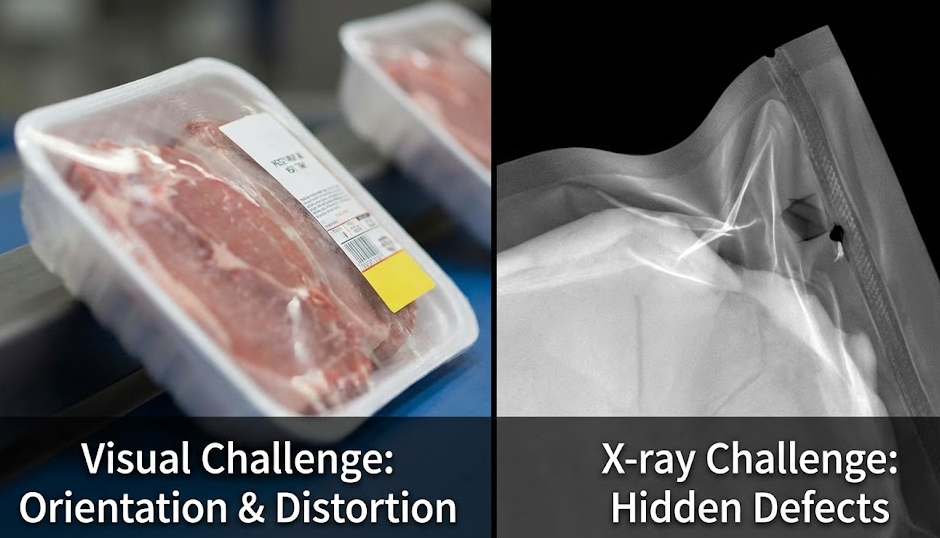
Relying on a single detection modality exacerbates this issue. X-ray technology, excellent for penetrating materials to reveal internal anomalies like foreign objects or density variations indicative of leaks, falls short in assessing surface aesthetics or printed information. Conversely, visible light cameras excel at capturing high-resolution images for external inspections—detecting scratches, dirt, or faded spray codes—but cannot "see" through opaque packaging to identify sealed-in defects. This dichotomy forces manufacturers to choose between incomplete coverage or cumbersome multi-step processes, increasing both time and error rates.
A second major pain point is the variability in product orientation during inspection. On high-speed conveyor belts, meat packages—whether pouches, trays, or vacuum-sealed bags—rarely align perfectly. They may tilt, overlap, or rotate, leading to captured images that vary in scale, angle, and perspective. What appears as a harmless shadow in one view might mask a critical defect in another. For example, a wrinkle on a curved surface could elongate or distort under different lighting and angles, confusing standard image-processing algorithms.
This positional inconsistency amplifies recognition difficulties. Traditional rule-based systems, which rely on predefined templates for defects, struggle with such diversity. A defect that matches a template in a frontal view might not register when viewed sideways, leading to false negatives (missed defects) or false positives (unnecessary halts). In a production line running at hundreds of units per minute, these errors disrupt flow, increase waste, and elevate costs. Moreover, irregular shapes common in meat packaging—such as flexible films conforming to uneven product contours—further complicate matters, as defects like oil leaks might spread unpredictably.
These challenges are compounded by environmental factors in manufacturing settings: varying lighting conditions, vibrations from machinery, and dust or moisture that can interfere with sensors. The result? Detection systems that are either overly sensitive (causing frequent false alarms) or insufficiently robust (allowing defects to slip through), both of which undermine efficiency and profitability.
Introducing Our Advantageous Solution: A Synergistic Approach
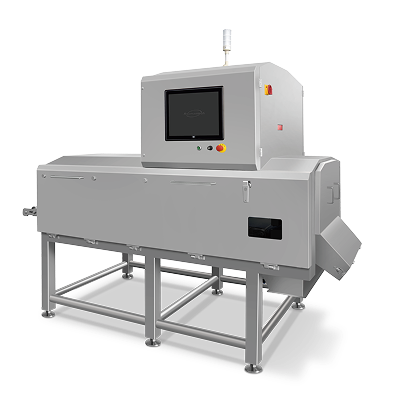
To surmount these obstacles, our innovative solution integrates an ultra-high-definition X-ray machine dedicated to sealing detection with a sophisticated visual detection system. This hybrid approach leverages the strengths of both technologies, delivering comprehensive, real-time inspections that address the full spectrum of packaging issues.
At the core of our system is the ability to perform synchronous detection of internal and external problems. The X-ray component penetrates the packaging to identify sealing defects such as material inclusions, oil seepage, or voids in the seal that could lead to leaks. By using high-resolution imaging, it can detect anomalies as small as a few millimeters, ensuring that even subtle internal issues are caught before they become liabilities. Meanwhile, the visible light module handles surface-level assessments: verifying the sharpness and correctness of spray-coded information, scanning for physical damage like punctures or dents, and spotting external contaminants such as debris or labels.
This combination eliminates the need for sequential inspections, streamlining the process and reducing bottlenecks on the production line. Imagine a vacuum-sealed pork loin package: the X-ray might reveal a tiny meat fragment trapped in the seal, while the visual camera confirms that the barcode is legible and the exterior is pristine. By fusing data from both sources, the system provides a holistic verdict, flagging only true defects and allowing flawless products to proceed unhindered.
Harnessing AI for Adaptive and Accurate Recognition
What sets our solution apart is its integration of advanced AI technologies, which empower the system to evolve with the demands of real-world production. Traditional detection relies on static algorithms, but ours supports targeted training on new defect samples. Manufacturers can input images of emerging issues—such as novel wrinkle patterns from a new packaging material—and the AI "learns" to recognize them through machine learning models.
This adaptability is crucial for handling the variability in product postures and defect morphologies. AI algorithms, trained on diverse datasets, can normalize images regardless of angle or size, using techniques like convolutional neural networks (CNNs) to extract features invariant to rotation or scaling. For irregular defects, such as amorphous oil stains or asymmetrical tears, the system employs deep learning to discern patterns that rule-based methods miss. Over time, as more data is fed in, recognition accuracy improves—often reaching 99% or higher in controlled tests.
The benefits extend beyond accuracy. AI-driven anomaly detection reduces false positives, minimizing unnecessary downtime. It also enables predictive maintenance: by analyzing trends in defects, the system can alert operators to upstream issues, like misaligned sealing machines, preventing recurring problems.
Flexible Customization for Seamless Integration
Recognizing that no two production lines are identical, our solution offers unparalleled flexibility in deployment. We customize the system to fit specific layouts, even in space-constrained environments. Whether it's a compact setup for small-scale processors or a scalable array for high-volume factories, our engineers design configurations that ensure precise sensor placement and stable operation.
This includes modular hardware that can be mounted overhead, sideways, or integrated into existing conveyors without major retrofits. Software-wise, user-friendly interfaces allow for easy parameter adjustments, such as sensitivity thresholds or inspection speeds, tailored to product types. In tight spaces, we employ compact X-ray sources and miniaturized cameras, maintaining performance without compromising safety standards like radiation shielding.
Performance metrics underscore the efficacy: in pilot implementations, our system has reduced defect escape rates by up to 95%, boosted throughput by 20-30%, and cut inspection-related waste significantly. Energy efficiency is another plus, with AI optimizing scan frequencies to conserve power.
Broader Implications and Future Outlook
Adopting such advanced detection not only resolves immediate pain points but also positions manufacturers for long-term success. Enhanced quality control translates to fewer recalls, stronger regulatory compliance, and elevated consumer satisfaction. In an industry facing pressures from sustainability (e.g., reducing packaging waste) and automation, our solution aligns with trends toward smart factories, where AI and IoT converge for predictive, efficient operations.
Looking ahead, integrations with blockchain for traceability or augmented reality for maintenance could further amplify value. For meat producers, investing in robust packaging detection isn't optional—it's essential for thriving in a competitive, scrutinized market.
In conclusion, by tackling the uncertainties of defect locations and product variability through a synergistic X-ray and visual system augmented by AI, our solution redefines outer packaging detection. It's a testament to how technology can turn industry challenges into opportunities for excellence, ensuring that every package leaving the line is a symbol of quality and reliability.

Related Articles
-
 Dec-10-2025
How Safe is X-ray Inspection of Food?
Consumers and manufacturers alike worry about contamination in food – broken glass, metal fragments, plastic or stone – entering a product and harming someone or prompting a recall. X-ray inspection systems have become a key solution: conveyors carrying packaged or unpackaged food pass through a shielded X-ray machine that “sees” inside each item. This technology complements traditional metal detectors and manual checks to catch a wider range of hazards. Importantly, extensive research and industry experience show that food X-ray inspection is extremely safe. Nearly everything we eat – from spices to snacks – is X-rayed at some point during production, and regulatory bodies (like the FDA) report “no known adverse effects” from the low-dose X-ray scans used in food plants.learn more -
 Dec-10-2025
RaymanTech X-ray Inspection Systems: The Complete Guide to a Smarter, Safer Production Line
When a single shard of glass, a fragment of bone, or an unnoticed plastic tie can trigger a multimillion-dollar recall and shatter consumer trust, food manufacturers can no longer rely on yesterday’s detection technology. RaymanTech has built an entire ecosystem of X-ray inspection solutions that go far beyond traditional metal detectors, delivering density-based, shape-aware, AI-enhanced inspection across every product format imaginable.learn more -
 Dec-10-2025
X-Ray Inspection of Cheese
Today, advanced X-ray inspection systems have become a critical plan for modern cheese processors. They move beyond simple metal detection to offer a complete quality assurance solution, protecting consumers and preserving brand integrity.learn more




Follow us:


