
 English EN
 Germany DE
 French FR
 Portuguese PT
 Spanish ES
In-Shell Pistachio Sorting Machine: AI Multi-View Optical Sorter for Defect Detection
Improving In-Shell Pistachio Quality Control with AI Optical Sorting
Pistachio processors face increasing requirements for consistent product quality, food safety, and production efficiency. During commercial processing, in-shell pistachios naturally vary in shell appearance, size, shape, and surface condition, making manual inspection and traditional sorting methods challenging for high-volume production.
Global pistachio processing and trade require consistent quality control for shell appearance, defect removal, and foreign matter separation, making precision sorting essential for commercial-scale production.
An AI multi-view optical sorter for in-shell pistachios combines high-resolution imaging, multi-angle inspection, and AI classification to analyze product appearance and automate sorting decisions.
Why Do Pistachio Processors Need Advanced Sorting Technology?
Challenges in In-Shell Pistachio Processing
In-shell pistachios naturally vary between growing regions, harvest conditions, and processing batches. These variations make it difficult to maintain consistent quality with manual inspection or simple sorting rules.
For commercial processors, key challenges include:
Maintaining consistent shell appearance
Removing unwanted products at production speed
Reducing manual sorting requirements
Minimizing good-product loss
Meeting customer and market specifications
For high-volume operations, sorting performance directly influences product consistency and usable yield.
Limitations of Traditional Color Sorting
Traditional pistachio color sorters primarily separate products according to predefined color differences. This approach works well for clear color variations, but more complex appearance patterns can be difficult to classify with fixed thresholds.
Shell discoloration, spots, and shape variations may differ significantly between batches. AI optical sorting takes a broader approach by analyzing multiple visual characteristics rather than relying only on a single color threshold.
How Does AI Multi-View Optical Sorting Work?
Multi-View Imaging for More Complete Inspection
In-shell pistachios have curved, irregular surfaces. A single viewing angle can leave parts of the shell outside the inspection field.
Multi-view imaging captures product information from multiple angles, providing more complete visual data for classification. This is particularly useful when defects may appear on different areas of the shell.
The inspection can evaluate characteristics such as:
Shell color
Surface patterns
Product shape
Visible abnormalities
AI-Based Classification
AI algorithms analyze image data and classify products according to learned appearance patterns.
Compared with conventional fixed-threshold color sorting, AI classification can handle more complex combinations of color, shape, and surface characteristics.
For processors, the practical objective is straightforward: separate target defects while retaining acceptable product under continuous production conditions.
How to Choose an In-Shell Pistachio Sorting Machine
Define the Sorting Targets
Start with the defects and quality requirements that matter most to your production line.
These may include:
Shell appearance
Non-split shells
Blanks
Foreign matter
Product shape
Overall grade consistency
The sorting system should be selected according to the actual product and target defects rather than equipment specifications alone.
Consider Chute-Type vs. Belt-Type Sorting
Both chute-type and belt-type optical sorters can be used for food sorting, but their product presentation is different.
Chute-type sorters are suitable for free-flowing products moving through the inspection area at high speed.
Belt-type sorters provide more controlled product positioning and can be useful when stable product presentation is important.
For in-shell pistachios, the appropriate configuration depends on throughput, product size, defect targets, feeding conditions, and the existing production layout.
Not sure which configuration fits your line? Contact RaymanTech to discuss your product and production requirements.
Evaluate Performance with Real Samples
Application testing is an important step before purchasing an optical sorter.
A typical evaluation includes:
Providing representative normal products and target defects
Running the actual samples through the sorter
Evaluating defect separation and good-product retention
Determining the appropriate machine configuration
Testing real material gives processors a more useful basis for equipment selection than theoretical specifications alone.
RaymanTech AI Multi-View Optical Sorting Solution for In-Shell Pistachios
The RaymanTech AI Multi-View Optical Sorter combines high-resolution imaging, multi-view inspection, and AI algorithms for automated separation of appearance defects and foreign matter in in-shell pistachios.
The system is designed for in-shell pistachio processors that need more detailed visual classification than conventional color-based sorting can provide.
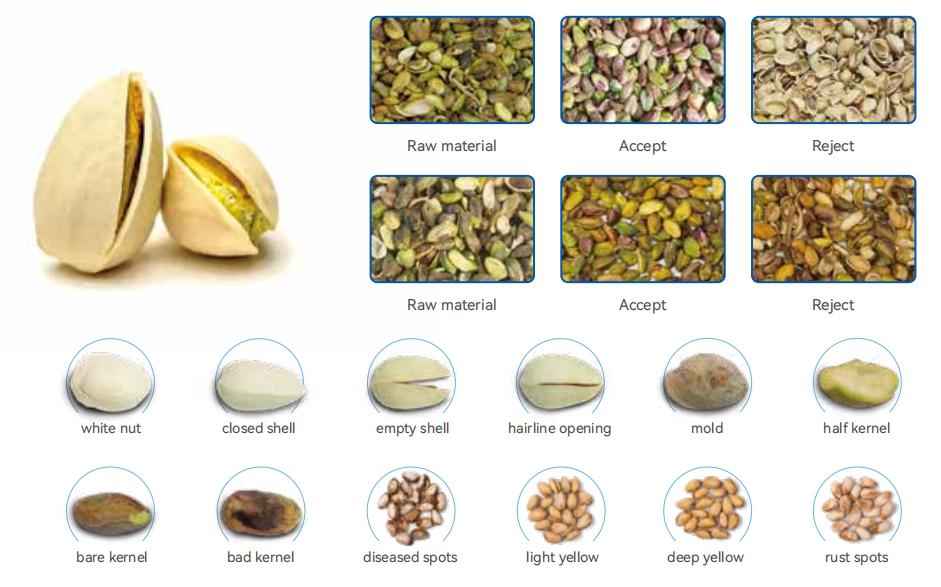
What Defects Can the RaymanTech Pistachio Sorter Detect?
For in-shell pistachio applications, the system can be configured to identify a range of visible product defects and unwanted materials.
The exact sorting configuration can be adjusted according to the product, defect characteristics, and processing requirements.
Multi-View Inspection for Irregular Shell Surfaces
A pistachio is a three-dimensional product rather than a flat object. Its curved shell can present different visual characteristics from different angles.
RaymanTech multi-view imaging captures multiple perspectives of the product during inspection. The additional image information gives the AI algorithm more visual evidence when classifying shell appearance and shape.
AI Sorting for Complex Appearance Variations
AI classification is useful when acceptable and unacceptable pistachios have subtle or overlapping visual characteristics.
Instead of defining a single color threshold for each defect, the system can analyze combinations of visual features. This makes it suitable for applications involving varied shell colors, spots, surface abnormalities, and shape differences.
Raw and Roasted Pistachio Sorting
Raw and roasted pistachios can present different visual characteristics.
Raw in-shell pistachios may show natural variation in shell color and surface appearance. Roasting can introduce additional color changes and heat-related surface marks.
For this reason, sorting parameters should be evaluated according to the actual product condition and processing stage.
RaymanTech application testing can help determine whether the selected optical configuration is suitable for a specific raw or roasted pistachio application.
From Sample Testing to Production Integration
A successful sorting project starts with the actual production requirement.
RaymanTech can evaluate customer samples to determine:
Target defect separation
Suitable imaging and sorting configuration
Product feeding requirements
Production-line integration considerations
Sample testing allows processors to assess the application before making an equipment investment and provides a practical basis for configuring the machine.
FAQ
What is an in-shell pistachio sorting machine?
An in-shell pistachio sorting machine is an automated system that uses optical imaging and sorting technology to identify and remove unwanted products, visible defects, and foreign matter during pistachio processing.
How does AI optical sorting work for pistachios?
AI optical sorting uses cameras and image-processing algorithms to analyze characteristics such as color, shape, and surface patterns. Products are classified according to learned visual features and separated automatically.
What defects can an AI pistachio sorter detect?
Depending on the application, an AI optical sorter can identify discoloration, non-split shells, blanks, blackened nuts, yellow spots, misshapen nuts, and foreign matter.
Internal defects with no visible external signs cannot be detected by optical imaging alone.
What is the difference between a pistachio color sorter and an AI optical sorter?
A traditional color sorter mainly uses predefined color differences for separation. An AI optical sorter can analyze multiple visual characteristics, including color, shape, and surface patterns, for more flexible classification of complex appearance variations.
Can an optical sorter handle both raw and roasted pistachios?
Yes, optical sorting can be applied to both raw and roasted pistachios. Because roasting changes product appearance, the sorting parameters should be evaluated using the actual product.
What information is needed for pistachio sample testing?
Processors should provide representative samples containing normal products and target defects. Information about product type, processing capacity, feeding method, production layout, and quality requirements can also help determine the appropriate machine configuration.
Test Your In-Shell Pistachio Samples with RaymanTech
The most reliable way to evaluate an optical sorting application is to test actual production samples.
Contact RaymanTech to arrange an in-shell pistachio sorting test and explore an AI multi-view optical sorting solution for your processing line.

Related Articles
-
.webp) Sep-02-2026
Sep-02-2026Residual Bone Detection in Boneless Chicken with Dual-Energy X-ray and AI
RaymanTech provides dual-energy X-ray inspection solutions for residual bone detection in boneless chicken applications. Compared with conventional single-energy X-ray, dual-energy systems provide additional material-related information that can support more challenging inspection tasks. RaymanTech’s dual-energy platform can also be combined with AI-based image analysis and classification for complex inspection applications.learn more -
 Sep-02-2026
Macadamia Kernel Sorting: AI Optical Sorting for Defect Detection and Quality Consistency
Learn how AI optical sorting helps macadamia processors detect visible defects, remove shell fragments and foreign materials, and improve grading consistency.learn more -
 Sep-02-2026
Green Coffee Bean Optical Sorting: AI Defect Detection and Foreign Material Removal
Learn how AI optical sorting helps green coffee processors detect visible defects, remove foreign materials, compare chute and belt sorters, and improve sorting accuracy.learn more




Follow us:
