
 English EN
 French FR
 Portuguese PT
 Spanish ES
The Critical Role of X-Ray Inspection for Shrimp
For seafood processors, protecting the consumer and the brand is paramount. A single, minuscule foreign object—a fragment of glass, a metal wire, a dense piece of plastic—can lead to consumer injury, a devastating product recall, and irreparable damage to a brand's reputation. Traditional inspection methods, while valuable, often fall short of this modern challenge.
This is where advanced X-ray inspection technology moves from a "nice-to-have" to a critical control point, ensuring safety, quality, and compliance in every package.
The Unique Contamination Challenges in Shrimp Processing
Shrimp processing is a multi-stage, intricate operation. Whether shrimp are peeled and deveined (P&D), cooked, or frozen, each step introduces specific risks. Machinery used for peeling, sorting, and conveyance can shed small metal fragments. Brittle plastics or glass from the processing environment can shatter.
The nature of the contaminant often depends on the type of shrimp product being processed. At RaymanTech, we focus on identifying the specific threats at each stage.
Here is a breakdown of the core challenges based on the product form:
Shrimp Product Type | Primary Inspection Focus | Common Contaminants |
Peeled & Deveined (P&D) Shrimp | Small, dense fragments in fresh or loose product. | • Metal: Shavings from peeling/deveining machines.
• Glass: Fragments from nearby equipment or lighting. |
Frozen Shrimp (Block or IQF) | Contaminants hidden within or between frozen items. | • Metal Wire: Often from cutting or binding machinery.
• Glass: Can be frozen into the block, invisible to the eye. |
Inspecting P&D shrimp requires a system with exceptional sensitivity to find tiny, low-density fragments scattered within a loose-fill product. Conversely, frozen shrimp blocks present an entirely different challenge: the X-ray must be powerful enough to penetrate the dense, frozen mass and intelligent enough to identify a contaminant hidden within it, not just on the surface.
Why X-Ray? The Technological Leap Beyond Metal Detectors
For decades, metal detectors were the industry standard. They are a crucial line of defense, but their utility has a clear limit: they only find metal.
The threats in a modern processing plant are far more diverse. X-ray inspection systems work on a different principle—density detection. The system sends low-energy X-rays through the product, and a sensor on the other side creates a grayscale image. Denser materials, like metal, glass, or calcified bone, absorb more X-rays and appear darker on the image, allowing the system to instantly identify and reject them.
This technology provides several distinct advantages:
Detects More Contaminants: It finds ferrous, non-ferrous, and stainless steel metals, just like a metal detector, but also detects glass, stone, high-density plastics, and rubber.
Inspects Through Packaging: X-ray is unaffected by metallic (foil) packaging or temperature changes, making it ideal for inspecting frozen blocks and ready-to-eat meals.
Enhanced Quality Control: Beyond contaminants, X-ray systems can perform simultaneous in-line quality checks, such as verifying product mass, identifying missing or broken items, and checking for package integrity.
Addressing Key Industry Questions
When adopting any technology, questions are natural. The most common ones we hear from seafood processors are:
1. Is X-ray inspection safe for my food product? Absolutely. The level of radiation used in food inspection is extremely low—significantly lower than a dental X-ray. It has no effect on the food's safety, flavor, texture, or nutritional value. It is a non-contact, non-invasive process approved by all global food safety bodies.
2. How does this fit into my HACCP or GFSI compliance? Advanced X-ray inspection is a cornerstone of a robust HACCP (Hazard Analysis and Critical Control Points) plan. It provides an auditable, verifiable, and highly effective critical control point for physical hazards. For processors seeking BRC, SQF, or other GFSI (Global Food Safety Initiative) certifications, a high-performance X-ray system is often the key to meeting and exceeding the most stringent standards.
RaymanTech's Specialized Solutions for Shrimp Inspection
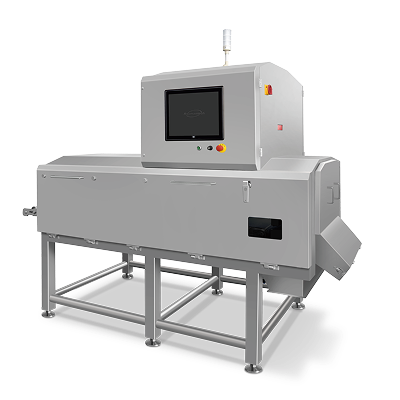
RaymanTech has developed highly specialized systems to target the unique challenges of the seafood industry.
For the intricate task of inspecting P&D shrimp, where contaminants are small and difficult to find, we recommend our X-Ray for Fish Bone Product. While the name highlights its incredible ability to find low-density calcified bones in fish fillets, this same high-sensitivity technology is perfectly adapted for shrimp. It excels at detecting those minute slivers of metal or glass fragments that other systems might miss, ensuring your P&D product is pure.
For more complex applications, such as frozen shrimp blocks, mixed seafood bags, or packaged products, the challenge becomes distinguishing a contaminant from the complex "image" of the product itself. Our AI X-Ray machine integrates cutting-edge artificial intelligence. This intelligent inspection dramatically enhances detection of foreign objects, even in "busy" or irregular products, while simultaneously reducing false positive rejections that can hurt line efficiency.
Conclusion
X-ray inspection is no longer an optional upgrade; it is a fundamental component of a modern, safe, and competitive seafood operation. By providing a clear, verifiable view inside every package, it offers the ultimate peace of mind.
To learn more about how RaymanTech's high-sensitivity and AI-powered X-ray systems can be integrated into your shrimp processing line, explore our seafood solutions today.

Related Articles
-
_1.png) Nov-20-2025
Nov-20-2025Beyond the Basics: A Professional Guide to Almond Sorting Technology
In the almond industry, quality is non-negotiable. Processors face a complex challenge: removing not only obvious foreign matter but also subtle product defects, internal damage, and micro-impurities. A single sorting machine is no longer the answer. Today, success demands an integrated, full-process strategy.learn more -
 Nov-20-2025
RaymanTech Bulk X-ray Inspection:The First and Most Important Line of Defense in Food Safety
In food processing, the highest-risk moment isn’t at the final packing station—it’s the second a truck backs up to the silo and unloads tons of raw nuts, grains, seeds, spices, dried fruit, coffee, or frozen vegetables. At that point, everything is mixed together: the good product you paid for, plus stones from the field, metal from harvesting equipment, glass from a broken bulb in the dryer, twigs, leaves, shells, insect-damaged kernels, moldy berries, and pieces of plastic baling twine.learn more




Follow us:


