
 English EN
 中国 CN
中国 CN
Metal Detectors in the Food Industry
Food processing lines often include conveyor belts fitted with metal detectors to catch unwanted metal fragments. In the food industry, metal is among the most common contaminants because machinery, blades, and packaging materials can introduce iron or steel shards into products. Modern metal detectors serve as a critical last line of defense: they scan packaged or loose food as it passes through a detection head and reject any items containing metal before they reach consumers. Thus, food safety regulations (GFSI, BRC, IFS, etc.) effectively require highly sensitive metal detection in production.
How Food Metal Detectors Work
Metal detectors for food typically use a balanced-coil or inductive sensing head. A transmitter coil generates an alternating magnetic field across the detector aperture, and paired receiver coils monitor the field for disturbances. When a metal contaminant (ferrous or conductive non-ferrous) enters the field, it induces a small current that causes a detectable imbalance. The detector’s electronics (often high-speed digital-signal processors, or DSP) analyze the change in signal amplitude and phase. If the signal exceeds a set threshold, the machine triggers an alarm or activates a reject mechanism. Most food detectors offer dual-frequency or multi-frequency modes: for example, RaymenTech units can switch between two frequencies to optimize sensitivity for different products. Dual-detection circuitry ensures that ferrous and stainless steels each reach their best sensitivity.
Beyond coil design, modern detectors include numerous refinements. RaymenTech’s models use special phase-adjustment and auto-balance AI algorithms to maintain a stable baseline, minimizing false alarms from vibrations or temperature drift. They often feature auto-learning functions: the detector quickly “learns” the normal signal of a new product and sets an optimal threshold. Touchscreen controls and USB ports allow easy setup and data logging. In summary, food metal detectors function as induction sensors tuned to the product, using advanced DSP filtering to spot the signature of metallic objects while ignoring the product itself.
What Types of Metals Can Be Detected?
Food industry detectors are calibrated to find three main metal categories:
Ferrous, non-ferrous, and stainless steels.
Ferrous metals (iron, steel) are both magnetic and conductive, so they produce strong signals and are easiest to detect. Non-ferrous metals like copper and aluminum are non-magnetic but still conductive, so they give a clear but somewhat weaker signal. Stainless steels (e.g. types 304, 316) are usually non-magnetic and have low conductivity, making them the hardest to pick up. In practice, a small non-magnetic stainless chip must often be roughly 1.5 times larger than an equivalent ferrous piece before it triggers the detector.
RaymenTech’s detectors explicitly target all three classes. For example, our conveyor-belt metal detector is “engineered to identify and reject ferrous, non-ferrous, and stainless steel materials” in food and pharmaceutical lines. The dual-detection system built into many RaymenTech models actively tunes separate sensing channels so that ferrous (Fe) and stainless (SUS) contaminants each reach maximum sensitivity.
In practice, a RaymenTech metal detector might reliably catch a 0.8 mm stainless steel wire and even smaller ferrous fragments in a dry product, due to these optimizations.
Sensitivity and Its Significance
A detector’s sensitivity is defined as the smallest metallic object it can reliably identify. Formally, it is often measured as the diameter of a spherical metal test piece detectable at the center of the aperture. Detectors have a maximum sensitivity rating (under ideal conditions with no product), and an in-product sensitivity (when actually inspecting food). Higher sensitivity means even tiny shavings or wire fragments are caught. This is crucial: regulators and customers demand that even the smallest contaminants be removed, because one small piece of metal can be devastating.
Actual sensitivity depends on many factors, but to give an idea:
a commonly cited guideline is that a 75 mm-high block of moist cheese requires about a 2 mm ferrous test ball or a 3.5 mm stainless ball to trigger a typical detector. In dry or frozen products, sensitivity can be better (smaller sphere), whereas in wet or salty products it degrades. In practice, factories calibrate their machines using tiny balls of each metal type to ensure the detector meets their target sensitivity. RaymenTech’s high-end detectors boast very low minimum detection sizes: for example, one of their gravity-fall units can detect ferrous metal down to ~0.5 mm in a controlled test, thanks to optimized head design and electronics.
Factors Affecting Detector Performance
Several factors influence how sensitively a metal detector can work in a production line:
Product Composition (Product Effect): Foods high in salt, moisture, fat or minerals can themselves perturb the magnetic field. This “product effect” can mimic a metal signal or mask it. Products that are wet, salty, or have varying density (like meats, cheeses, or sauces) create false signals and reduce detection accuracy. For instance, hot or freshly baked breads (high moisture, carbonized surfaces) are notoriously challenging. Many meats, poultry and seafood items likewise have significant product effect. Multi-frequency detectors (like RaymenTech’s ) help mitigate this by allowing different frequencies that interact less with certain product properties.
Packaging: The material and shape of the package can affect sensitivity. Conductive packaging (such as metalized film, foil, or cans) will absorb or distort the detector’s field. For example, inspecting a product in an aluminum-coated bag can dramatically reduce sensitivity to contaminants inside. It’s often best to metal-detect before packaging if possible, or use specialized high-sensitivity modes.
Environmental Conditions: Temperature swings, humidity, vibration or nearby electrical equipment can degrade performance. Significant temperature fluctuations can change the detector electronics’ baseline, and RF interference (e.g. from motors) can introduce noise. Operators are advised to keep the machine in a stable climate and away from strong electromagnetic sources. RaymenTech units often include internal auto-balance systems and phase-shift control to compensate for moderate environmental changes.
Detector Settings: The aperture size, conveyor speed, and especially the frequency setting are crucial. Larger apertures inherently reduce sensitivity (a 1 mm target under a huge 600 mm aperture is barely detectable). Each product requires tuning the frequency: dry products usually need higher frequencies, while wet products work better with a combination of high and low (multi-scan modes). RaymenTech detectors allow fast frequency changes and have predefined settings (“auto-learning”) to adapt to different products. Finding the right balance of sensitivity vs. false-reject rate is a constant calibration task in the plant.
Common Applications in Food Industries
Metal detectors are used on virtually every processing line.
Meat and Poultry
In meat and poultry plants, detectors catch metal fragments that may come from broken vaccination needles, knives, cutters or bone splinters. Used on lines for raw and processed meats, RaymenTech conveyor detectors scan cuts, ground meat, sausage, poultry and other products. They catch bits of metal from equipment wear or bone fragments, preventing recalls.
Dairy Products
In cheese, milk, yogurt and butter production, detectors ensure dairy goods are free from metal shards. RaymenTech supplies high-sensitivity pipeline and gravity-fall units for liquid dairy (milk, cream, yogurt) and powdered dairy (whey powder, cheese curds).
Seafood
Fresh, frozen or canned fish and shellfish pass through RaymenTech’s metal detectors on conveyors. These units detect any metal contaminants picked up from nets, hooks or processing machines.
Grain and Cereal
Bulk grains (rice, wheat, corn, oats) are fed through detectors to remove stray metal before milling or bagging. RaymenTech’s gravity-feed detectors are commonly installed at the head of such lines. They can even reject metal bits in high-throughput grain flows with sensitivity down to about 0.5–1 mm ferrous.
Sugar and Confectionery
Powdered sugar and sweeteners behave like bulk powders, so falling-product detectors are used. RaymenTech’s gravity-fall model (IMD-P series) is explicitly designed for powders and granules. In candy and chocolate lines, conveyor detectors (often combined with checkweighers) inspect wrapped confections for metal contamination.
RaymenTech Metal Detector Models and Innovations
RaymenTech offers a broad range of specialized detectors. Conveyor Belt Metal Detectors (models IMD-*) are flagship units. These were the first DSP-driven conveyors developed in China. They feature cutting-edge sensors and firmware: for example, dual-frequency selection lets the operator tune one frequency for ferrous and another for non-ferrous detection. RaymenTech also implements a proprietary phase-adjustment algorithm for stable, noise-resistant detection. The touch-screen interface, multi-language menus and USB data ports are designed for ease of use and traceability.
For powders and granules, RaymenTech’s Gravity Fall Metal Detector (IMD-P) has a compact vertical tube. The product free-falls through the detection head, and even small metals are detected. This unit can achieve extremely high sensitivity; for example, in tests it detects ferrous spheres as small as 0.5 mm. The gravity detector is ideal for sugar, flour, powdered milk, spices and salt.
RaymenTech also produces specialty heads: a Biscuits-Type detector with a pneumatic retracting belt to gently handle fragile snacks, and Pipeline Detectors for pumped liquids (sauces, soups). The Pharmaceutical Tablet/Tablet-Press Detector is tuned for very high sensitivity in pill or capsule production (down to 0.7 mm Fe). Many RaymenTech detectors incorporate auto-learning: they quickly memorize a product’s “normal” signal during a calibration phase. Some models include multi-spectrum detection (using multiple coils or frequencies simultaneously) for enhanced accuracy.
Why RaymenTech Stands Out Globally
RaymenTech has grown into a major global supplier of metal detection equipment. We have complete R&D, production, and inspection lines and strict QC at each step. Every metal detector is calibrated and tested under supervision before shipment to ensure consistent performance.
Moreover, RaymenTech’s machines have earned international reach. Our equipment is sold worldwide – in the USA, Germany, Japan and elsewhere in Europe and Asia. Local branches (In USA) and a network of distributors ensure timely support.
We highlights customer-focused features: customizable apertures, multilingual interfaces, and integration with factory systems. The combination of advanced technology (DSP, multi-spectrum, etc.) with Reliable production gives RaymenTech detectors a strong value proposition. Our metal detectors deliver cutting-edge detection capabilities with high-sensitivity sensors to keep food safe across diverse industries. This blend of innovation, breadth of models, and global service helps RaymenTech stand out in the competitive food-inspection market.

Related Articles
-
 Nov-03-2025
Principle of X-ray Inspection Machines in the Food Industry
Learn how food X-ray inspection machines detect metal, glass, stone, and bone contaminants—even in foil packaging—for superior food safety and quality control.learn more -
 Nov-03-2025
Advancing Food Safety:Overcoming Challenges in Residual Bone Detection in Meat Processing
In the high-volume world of meat processing,product safety is non-negotiable. Consumers demand contaminant-free meat,and even a single oversight can trigger health risks,costly recalls,or lasting reputational damage.Among the most stubborn threats are residual bone fragments—tiny,sharp shards that persist after mechanical deboning.These fragments can cause choking,oral injury,or digestive tract damage,directly undermining food safety standards.learn more -
 Nov-03-2025
X-Ray Technology: Safeguarding Poultry Product Safety
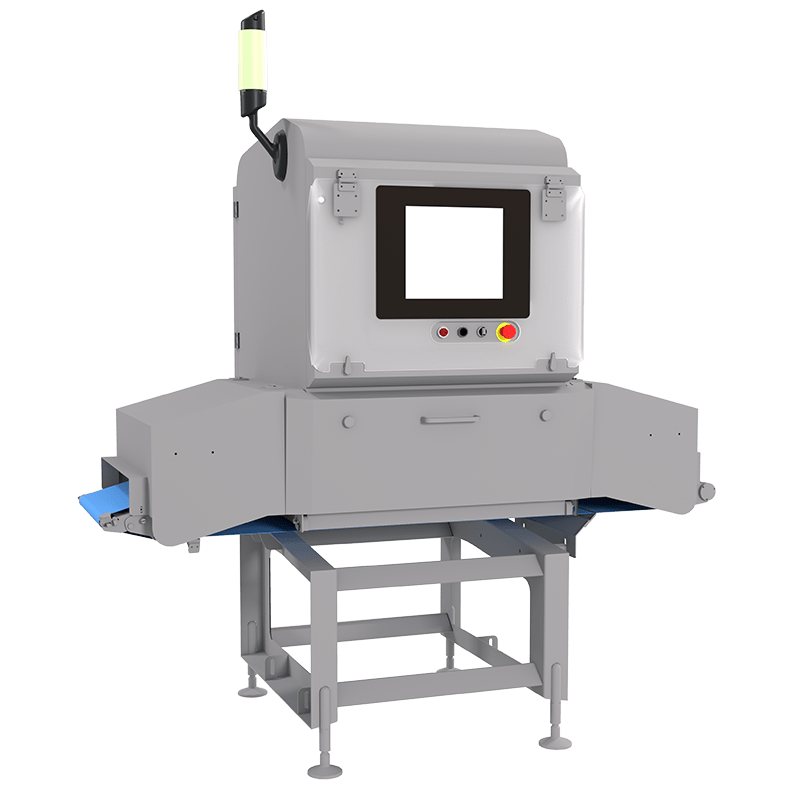
Poultry processors face increasing demands for food safety and quality. Bone fragments or foreign materials such as metal, glass, or ceramic can appear in chicken breasts, thighs, whole chickens, and processed products like nuggets or patties. Raymantech X-Ray Inspection Systems make this process safer and smarter by detecting even tiny or low-density contaminants that traditional methods often miss.learn more




Follow us:


