
 English EN
 Germany DE
 French FR
 Portuguese PT
 Spanish ES
IQF Optical Sorting for Frozen Fruits and Vegetables: Improving Quality, Defect Detection, and Foreign Material Control Delivering Consistent, Safe, and High-Quality IQF Products with Intelligent Optical Sorting
Delivering Consistent, Safe, and High-Quality IQF Products with Intelligent Optical Sorting
IQF (Individual Quick Frozen) fruits and vegetables are widely used in modern frozen food applications, including frozen retail products, smoothies, bakery ingredients, ready meals, foodservice applications, and food manufacturing.
As food quality standards continue to increase, IQF processors require reliable solutions to achieve consistent product quality, effective foreign material control, stable production performance, and improved production efficiency.
RaymanTech intelligent optical sorting solutions support frozen food processors with advanced imaging, AI-powered recognition, and automated sorting technologies.
This article introduces common IQF sorting challenges and explains how optical sorting machines for frozen food enable more reliable defect detection, foreign material removal, and quality control.
1. Why IQF Optical Sorting Matters in Frozen Fruit and Vegetable Processing
Supporting Reliable Quality Control in Modern Frozen Food Production
For IQF processors, maintaining consistent quality directly impacts customer satisfaction, production efficiency, and long-term business performance.
Manufacturers supplying retail, foodservice, and food industry customers need to maintain stable product standards across large production volumes.
Key production goals include:
✓ Consistent product appearance
✓ Reliable quality standards
✓ Efficient production management
✓ Reduced dependence on manual inspection
As production capacity increases, maintaining stable quality control becomes more challenging.
Traditional manual inspection can be difficult to standardize in high-speed production environments due to:
· Different operator judgments
· Changing raw material conditions
· Increasing quality requirements
Automated optical sorting enables processors to establish a more standardized inspection process and enhance production reliability.
By integrating IQF optical sorting machines into frozen food processing lines, manufacturers can better manage product variations and maintain consistent quality requirements.
2. Common Sorting Challenges in IQF Frozen Fruit and Vegetable Processing
IQF fruits and vegetables present unique sorting challenges due to their natural characteristics, irregular structures, and frozen processing conditions.
Unlike standardized industrial products, frozen fruits and vegetables require advanced sorting technologies to accurately identify defects, foreign materials, and quality variations during continuous production.
2.1 Foreign Material Detection Challenges
Identifying Small and Similar-Appearance Foreign Materials
Foreign material detection is a critical requirement in IQF fruit and vegetable processing.
However, some contaminants are difficult to identify because they are small or have a similar appearance to good products.
Common challenging foreign materials include:
· Hair
· Fine fibers
· Insects
· Foreign materials with similar colors to products
These materials increase the difficulty of achieving stable and accurate sorting performance, especially in high-speed IQF production.
For IQF processors, effective foreign material detection requires reliable inspection capability to identify unwanted materials while maintaining production efficiency.
2.2 Defect Detection Challenges Caused by IQF Product Characteristics
Handling Irregular Shapes and Complex Product Surfaces
IQF fruits and vegetables often have irregular shapes and multi-dimensional surfaces, making defect detection more challenging.
Single-view inspection may create blind spots when analyzing product surface conditions.
Frozen processing conditions can further increase inspection difficulty due to:
· Frost and ice crystals
· Surface reflection
· Complex product backgrounds
These factors make it more difficult to obtain complete and stable product information during inspection.
For processors handling natural agricultural products, sorting systems need to adapt to different product shapes, appearances, and quality conditions.
2.3 Rejection Challenges in High-Speed IQF Production
Achieving Accurate Removal While Protecting Good Products
Accurate detection needs to be supported by reliable rejection performance.
During high-speed IQF production, different material characteristics can affect rejection stability, including:
· Lightweight contaminants such as hair and fine fibers
· Long and irregular-shaped materials
· Large and heavier product pieces
Different materials require optimized rejection strategies to achieve accurate removal.
A stable reject system needs to provide precise control to remove unwanted materials while:
✓ Minimizing impact on good products
✓ Reducing product loss
✓ Maintaining continuous production efficiency
3. How RaymanTech IQF Optical Sorting Machines Solve Processing Challenges
Advanced Sorting Technologies for More Reliable Quality Control
IQF processing requires sorting solutions that can handle natural product variations, complex surface conditions, and high-speed production requirements.
With extensive experience in food inspection and sorting applications, RaymanTech develops IQF optical sorting solutions designed for different frozen fruit and vegetable processing requirements.
RaymanTech optical sorting machines integrate multiple intelligent technologies to enhance sorting accuracy, quality consistency, and production reliability.
Key technologies include:
✓ Ultra-High-Definition (UHD) Imaging Technology
✓ Multi-view inspection
✓ AI-powered recognition
✓ NIR technology
✓ Intelligent reject systems
✓ Data-based optimization
Together, these technologies enable processors to improve defect detection, foreign material removal, sorting consistency, and overall quality control across different frozen fruit and vegetable applications.
Ultra-High-Definition (UHD) Imaging Technology for More Accurate Sorting
Ultra-high-definition (UHD) imaging technology provides clearer and more detailed product information during IQF sorting.
Advanced imaging capability captures fine surface details, enabling optical sorting machines to better analyze product appearance and make more accurate classification decisions.
In IQF processing, natural raw material variations can create subtle appearance differences.
UHD imaging technology enables sorting systems to capture these differences more effectively and enhance inspection reliability.
Key advantages include:
✓ Clearer image acquisition
✓ More detailed product analysis
✓ Improved sorting accuracy
For frozen fruits and vegetables with complex appearance variations, UHD imaging technology provides a stronger foundation for stable and accurate sorting performance.
Multi-View Inspection for More Complete Product Analysis
Many IQF fruits and vegetables have irregular shapes and multi-dimensional surfaces.
Single-view inspection may not provide complete product information, especially when products have uneven surfaces or complex structures.
RaymanTech multi-view inspection technology captures product information from multiple angles to improve inspection completeness.
It helps address challenges caused by:
· Irregular product shapes
· Different surface conditions
· Limited viewing angles
This capability is particularly valuable for frozen fruits and vegetables where complete surface inspection is difficult to achieve with traditional single-angle systems.
By obtaining more complete product information, multi-view inspection reduces detection blind spots and enhances sorting reliability for challenging IQF applications.
AI-Powered Recognition for Smarter Sorting Classification
AI technology plays an important role in modern optical sorting by enhancing recognition capability and enabling more flexible sorting performance.
RaymanTech AI-powered recognition technology analyzes product characteristics and complex patterns to distinguish between:
· Good products
· Defective pieces
· Foreign materials
AI recognition is especially valuable for IQF applications where products may have:
· Slight appearance differences
· Complex defect patterns
· Similar visual characteristics between products and foreign materials
· Natural variations between different production batches
Unlike traditional sorting methods based on fixed inspection rules, AI-powered recognition can analyze changing product conditions and adapt to different sorting requirements.
Natural agricultural products can vary due to:
· Seasonal changes
· Growing conditions
· Raw material sources
These variations may affect product appearance and create challenges for maintaining stable sorting performance.
AI technology enables sorting systems to better understand product variations and maintain consistent recognition capability across different production conditions.
Key advantages include:
✓ Improved defect classification
✓ Better adaptability to product variations
✓ More stable sorting performance
By enhancing recognition accuracy, AI helps reduce false rejects and missed detection while supporting stable IQF production.
NIR Technology for Additional Material Identification Capability
Visible light inspection can meet many IQF sorting requirements, but some applications may require additional material identification capability.
Near-infrared (NIR) technology analyzes material characteristics beyond visible appearance and provides an additional inspection dimension.
NIR technology supports applications where RGB vision may have limitations and helps processors obtain more comprehensive sorting information.
By combining different inspection technologies, optical sorting systems can better address complex IQF sorting requirements.
High-Performance Rejection System for Precise Material Removal
Accurate detection requires a reliable rejection system to achieve effective removal of unwanted materials during high-speed IQF production.
RaymanTech rejection technology provides precise removal capability for different material types, including:
· Lightweight contaminants such as hair and fine fibers
· Long and irregular-shaped materials
· Large and heavier product pieces
The system provides optimized rejection control according to product characteristics to achieve:
✓ Accurate material removal
✓ Stable rejection performance
✓ Reduced good product loss
A reliable rejection system ensures detected unwanted materials are removed accurately while protecting valuable products during continuous production.
Data-Based Optimization for Continuous Sorting Improvement
Modern optical sorting systems provide more than detection and rejection.
By collecting and analyzing sorting data, processors can better understand equipment performance and optimize operating parameters.
Data-based optimization supports:
✓ Sorting result analysis
✓ Parameter adjustment
✓ Production monitoring
✓ Continuous process improvement
Through data feedback, IQF processors can maintain stable sorting performance and make informed adjustments according to production conditions.
This capability supports long-term quality control and more transparent production management.
4. IQF Optical Sorting Applications
RaymanTech optical sorting solutions have been applied to different IQF fruit and vegetable processing applications.
The following examples demonstrate typical sorting targets for frozen food processing.
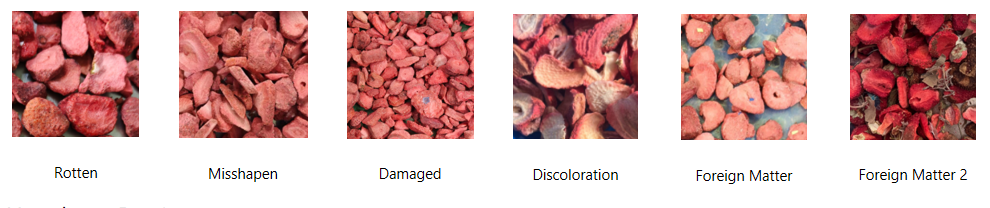
Frozen Strawberry Optical Sorting Solution
Sorting targets:
· Rotten
· Abnormal color
· Abnormal shape
· Foreign materials
· Damaged
Frozen Blueberry Optical Sorting Solution
Sorting targets:
· Leaves, stems, and foreign materials
· Abnormal color
· Shriveled or split blueberries
· Abnormal shape
· Abnormal size

Frozen Carrot Slices Optical Sorting Solution
Sorting targets:
· Lignified
· Discoloration
· Misshapen
· Foreign materials

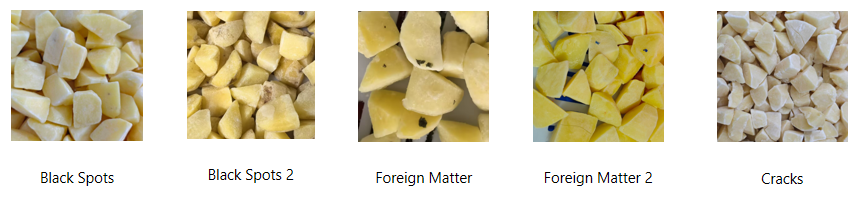
Frozen Potato Cube Optical Sorting Solution
Sorting targets:
· Black spots
· Cracks
· Foreign materials
5. Benefits of Intelligent Optical Sorting for IQF Food Processors
Supporting Better Quality Control and Production Stability
For IQF food processors, optical sorting provides value beyond defect removal.
It supports consistent quality management, improved production efficiency, and stable long-term operation.
Improved Product Consistency
Optical sorting technology supports more consistent:
· Product appearance
· Color quality
· Product standards
This enables processors to maintain stable product quality for retail, foodservice, and food manufacturing applications.
Stronger Foreign Material Control
Advanced optical sorting capability enhances foreign material detection and removal performance.
This supports stricter quality requirements and helps reduce risks associated with unwanted materials in finished products.
Higher Yield Protection
Accurate classification and rejection enable processors to remove unwanted materials while minimizing loss of good products.
Better sorting accuracy helps protect valuable raw materials and maintain production efficiency.
Reduced Labor Dependency
Automated optical sorting reduces manual inspection workload and provides stable sorting performance during continuous production.
This supports higher operational efficiency and reduces dependence on manual sorting processes.
Better Production Control
Modern sorting systems provide production information to support:
· Process optimization
· Quality management
· Production transparency
This enables IQF processors to continuously optimize sorting performance based on production data.
6. Get Your IQF Optical Sorting Solution
Selecting the right IQF optical sorting solution requires understanding:
· Product characteristics
· Defect types
· Production conditions
· Quality requirements
RaymanTech provides application-based solution recommendations through:
✓ Product sample testing
✓ Sorting performance evaluation
✓ Customized solution design
By evaluating actual product samples and processing requirements, RaymanTech helps IQF processors identify suitable optical sorting solutions for their production needs.
Contact RaymanTech to discuss your IQF sorting requirements and evaluate a suitable optical sorting solution based on your product characteristics and production goals.
7. Frequently Asked Questions
What IQF products can RaymanTech optical sorting machines process?
RaymanTech IQF optical sorting solutions can be applied to a wide range of frozen fruits and vegetables, including strawberries, blueberries, raspberries, cherries, carrots, green beans, peas, corn, and potatoes.
Additional IQF fruits and vegetables can also be evaluated based on product characteristics, defect types, production conditions, and quality requirements.
Can RaymanTech test our IQF product samples before equipment selection?
Yes.
RaymanTech provides product sample testing to evaluate sorting performance using actual customer materials.
Sample testing helps customers verify:
· Detection capability
· Sorting performance
· Solution suitability
before selecting the right IQF optical sorting solution.
Testing actual product samples allows processors to understand expected sorting performance under practical production conditions and make decisions based on real application results.
How do we choose the right IQF optical sorting solution?
The suitable sorting solution depends on:
· Product characteristics
· Defect types
· Production capacity
· Quality requirements
RaymanTech provides application-based recommendations through product sample testing, sorting performance evaluation, and customized solution design.
By understanding each customer’s production conditions and quality objectives, RaymanTech helps processors select suitable sorting configurations for their IQF applications.

Related Articles
-
 Jul-10-2026
RaymanTech X-ray Inspection Systems: The Complete Guide to a Smarter, Safer Production Line
When a single shard of glass, a fragment of bone, or an unnoticed plastic tie can trigger a multimillion-dollar recall and shatter consumer trust, food manufacturers can no longer rely on yesterday’s detection technology. RaymanTech has built an entire ecosystem of X-ray inspection solutions that go far beyond traditional metal detectors, delivering density-based, shape-aware, AI-enhanced inspection across every product format imaginable.learn more -
 Jul-10-2026
Introduction to RaymanTech Optical Sorters for Farm Products and Food Processors
RaymanTech, as a leading provider of inspection and sorting solutions, has developed a comprehensive optical sorter portfolio that now serves both farm-product applications and food-processing environments. While farm-product sorters focus on capacity, adaptability, and raw-material variability, food-processor-grade sorters must also incorporate high IP protection, robust stainless-steel construction, sanitary design, and harsh washdown compatibility.learn more -
Jul-10-2026
How AI Is Changing the Game in Food Foreign Material Detection
AI enhances food foreign material detection by improving accuracy, speed, and reliability, reducing recalls and boosting food safety in manufacturing.learn more




Follow us:
