
 English EN
 Germany DE
 French FR
 Portuguese PT
 Spanish ES
Green Coffee Bean Optical Sorting: AI Defect Detection and Foreign Material Removal
Green coffee beans naturally vary in color, size, shape, and surface condition because of differences in origin, variety, growing conditions, and post-harvest processing. For dry mills, coffee processors, exporters, and roasters, consistent sorting helps maintain lot quality, meet customer specifications, and protect saleable product.
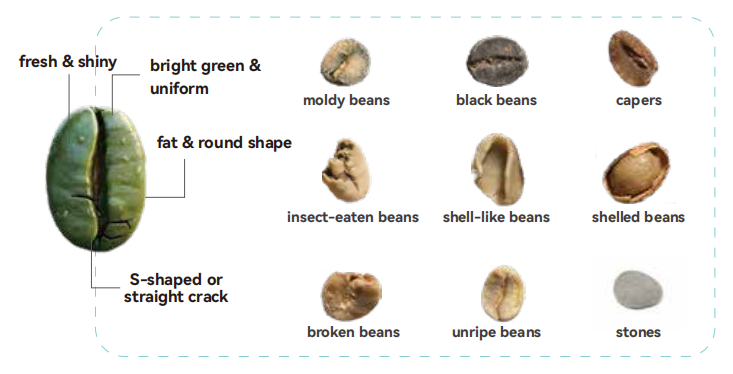
Common sorting targets include black and sour beans, unripe or pale beans, insect-damaged beans, broken and misshapen beans, shell material, and unwanted plant debris. Traditional color sorting can handle straightforward color differences, but complex coffee defects often require more than hue and brightness analysis.
RaymanTech optical sorting combines full-color imaging, AI-based classification, shape analysis, and multi-view inspection to identify and separate a broader range of visible defects. When dense or concealed foreign materials present an additional food safety risk, X-Ray inspection can be added as a complementary inspection step.
Green Coffee Sorting at a Glance
Key Takeaway: Optical sorting addresses visible coffee defects and unwanted material, while X-Ray inspection provides complementary detection for dense contaminants that may be hidden from visual inspection.
Common Green Coffee Defects and Inspection Targets
Green coffee defects can develop during cultivation, harvesting, drying, hulling, storage, and transportation. Their commercial importance varies by grade, origin, and buyer specification.
For practical sorting applications, the main targets can be grouped into four areas:
Color and ripeness defects: black beans, sour or discolored beans, pale or unripe beans, and abnormal coloration.
Structural defects: broken, chipped, misshapen, and shell beans, together with loose parchment or husk material.
Insect and surface damage: visible insect holes, scars, blemishes, and pest-related discoloration.
Foreign materials: stones, sticks, leaves, plant debris, husk, parchment, and other visually distinguishable contaminants.
ISO 10470:2004 provides an international reference framework for green coffee defect classification. The standard lists major categories of defects found in green coffee traded internationally and provides a basis for assessing their effect on mass loss and sensory quality.
U.S. FDA guidance also addresses insect infestation, insect damage, mold, and other defects in green coffee. Its Macroanalytical Procedures Manual specifically describes examination of green coffee beans for insect, mold, deterioration, and extraneous material, including visual and X-Ray examination methods.
The goal of optical sorting is not maximum rejection, but targeted removal of specified defects while preserving acceptable coffee and stable grading quality.
What Can RaymanTech Optical Sorters Separate?
RaymanTech systems can be configured around the actual defect profile and grading requirements of a coffee processor.
These targets are based on visible characteristics that an optical sorter can evaluate. Actual sorting performance depends on defect characteristics, product presentation, loading density, and sorting criteria. Application testing with representative coffee samples helps determine the appropriate configuration.
RaymanTech AI Optical Sorting for Green Coffee
AI-Based Classification
Conventional color sorting primarily relies on predefined color and brightness thresholds. This approach can become less effective when acceptable green coffee naturally spans a wide range of colors or when defects have subtle visual differences.
RaymanTech AI classification evaluates multiple visual characteristics, including color, brightness, shape, size, surface appearance, and defect patterns. This allows the system to distinguish acceptable natural variation from targeted reject conditions more effectively than a single-threshold approach.
The practical objective is controlled defect removal with lower unnecessary rejection of saleable beans.
Multi-View Imaging
Green coffee beans are three-dimensional and can rotate during sorting. A single viewing direction may leave part of a bean outside the inspection field.
Multi-view imaging captures product from multiple directions, providing more surface information to the inspection algorithm. This can improve detection consistency for surface defects, insect damage, irregular shapes, and foreign material that may not be clearly presented from one angle.
Optical Sorting vs. X-Ray Inspection
The two technologies address different inspection requirements and are best viewed as complementary.
Optical sorting focuses on visible characteristics such as:
Color and discoloration
Shape and size
Surface defects
Visible insect damage
Shell, parchment, and plant material
Visually distinguishable foreign materials
X-Ray inspection identifies dense materials based on differences in X-Ray attenuation. It can provide an additional inspection layer for metal, glass, stones, and other dense contaminants, particularly when they are hidden or difficult to identify visually.
A clearly exposed stone or metal fragment may also be separated by optical sorting if it provides sufficient visual contrast. X-Ray becomes more valuable when the contaminant is concealed, embedded, or visually similar to the coffee.
RaymanTech Green Coffee Sorting Solutions
RaymanTech provides both chute and belt optical sorting platforms for coffee processing, allowing the equipment configuration to match product presentation, throughput, and inspection requirements.
Rather than selecting equipment from a generic specification sheet, RaymanTech recommends application testing with actual coffee samples. Origin, processing method, bean size, defect profile, and customer specifications can all affect sorting results.
Chute Optical Sorters
For high-volume green coffee processing, chute optical sorters provide efficient bulk sorting with a compact product flow. They are well suited to standard defect removal and grading applications, including black and discolored beans, unripe beans, broken or misshapen beans, shell material, and visible foreign matter.
Belt Optical Sorters
Belt optical sorters provide controlled product presentation and broader inspection coverage. RaymanTech belt systems can incorporate AI classification, multi-view imaging, IP66-rated protection, and speeds of up to 240 m/min on applicable configurations.
They are particularly suitable when controlled presentation, surface inspection, and flexible sorting criteria are important.
Chute vs. Belt: Which Coffee Sorter Is Right?
The right choice depends on the actual coffee, defect profile, throughput, and inspection objectives, rather than machine type alone.
6 Key Considerations Before Buying a Coffee Sorter
Define priority defects — Identify the defects that have the greatest impact on grade, customer requirements, and product loss.
Match capacity to real throughput — Actual capacity depends on bean size, loading density, product presentation, and sorting criteria, not maximum reference speed alone.
Evaluate product presentation — Consistent presentation directly affects inspection coverage and sorting stability.
Balance defect removal and yield — The objective is to meet quality specifications without unnecessarily rejecting saleable coffee.
Consider complementary X-Ray inspection — Add X-Ray when concealed dense foreign materials represent a significant food safety risk.
Test with actual samples — Application testing provides the most reliable basis for selecting the machine type and configuration.
FAQ
Can optical sorting remove black and discolored coffee beans?
Yes. Color and brightness separation is a core function of optical sorting. AI classification can add shape and surface analysis for more complex defect profiles.
Can a coffee sorter detect insect-damaged beans?
It can target visible insect holes, scars, and pest-related discoloration when these features provide sufficient visual distinction. Actual performance should be validated with representative samples.
Can optical sorting detect Quaker beans?
Optical sorting can remove beans with visual characteristics associated with underdevelopment, such as pale coloration. However, Quaker characteristics are most clearly confirmed after roasting, so optical sorting should be considered a pre-roast quality control step rather than a complete replacement for roast evaluation.
What is the difference between a color sorter and an AI optical sorter?
A conventional color sorter primarily evaluates color and brightness. An AI optical sorter can combine color, shape, size, surface characteristics, and defect patterns for broader classification.
When should X-Ray inspection be added to a coffee line?
X-Ray is particularly relevant when stones, glass, metal, or other dense contaminants may be hidden or difficult to detect through visual inspection.
Can the same sorter work for green and roasted coffee?
Some platforms can be configured for both applications, but green and roasted coffee differ substantially in color, density, surface appearance, and defect characteristics. Application testing is recommended before using one configuration across both products.
Test Your Green Coffee Sorting Application
Sorting performance depends on the actual product—not machine specifications alone.
RaymanTech provides application-specific testing with representative green coffee samples to evaluate defect separation, product recovery, foreign material removal, throughput, and the appropriate chute or belt configuration.
Testing can also determine whether AI classification, multi-view imaging, or complementary X-Ray inspection is appropriate for the application.
The objective is straightforward: meet the required quality specification while controlling product loss and maintaining repeatable sorting performance.
Contact RaymanTech to submit your green coffee samples and evaluate a tailored coffee sorting solution.
Industry References
ISO 10470:2004 — Green coffee — Defect reference chart
International reference for green coffee defect classification. ISO confirms that the 2004 edition was last reviewed and confirmed in 2017 and remains current.
U.S. FDA CPG Sec. 510.500 — Green Coffee Beans: Adulteration with Insects; Mold
FDA regulatory guidance addressing insect-infested, insect-damaged, and moldy green coffee beans. The guidance specifies an average of 10% or more by count as one criterion for direct reference seizure.
U.S. FDA Macroanalytical Procedures Manual — Method for Coffee Beans
FDA's method covers defects caused by insects, mold, deterioration, and extraneous matter and includes both visual and X-Ray examination procedures.

Related Articles
-
Aug-27-2026
Best Carrot Sorting Machine: Top Picks for Efficient Farming
A practical guide to choosing the best carrot sorting machine for your farming operation. We compare top optical sorting systems for fresh, frozen, and processed carrots, covering key factors like throughput, defect detection, and product handling. Learn which machine fits your farm's specific needs.learn more -
 Aug-27-2026
IQF Frozen Carrot Sorting Solution for Color Defect Detection, Specification Control, and Foreign Material Removal
AI optical sorting for IQF frozen carrots: color defect detection, size and shape control, foreign material removal, and reduced false rejects before final packaging.learn more -
 Aug-27-2026
IQF Frozen Broccoli Sorting Solution: AI Optical and X-Ray Inspection
IQF frozen broccoli inspection combining AI optical sorting and X-Ray detection to control color variation, blemishes, damaged pieces, unwanted plant material, visible insects, and dense foreign materials before packaging.learn more




Follow us:
