
 English EN
 Germany DE
 French FR
 Portuguese PT
 Spanish ES
Post-roast AI optical sorting for quaker beans, roast-color variation, and foreign materials in whole-bean coffee production
Coffee quality is shaped by every stage of production, from cultivation and processing to roasting and packaging. For specialty coffee roasters and packaged coffee manufacturers, maintaining reliable product standards requires careful control throughout the entire process.
Roasted coffee quality is not determined solely by green coffee selection. After roasting, quaker beans, uneven roast development, and physical defects can still affect the quality of the finished product.
Green coffee sorting plays an important role in controlling incoming raw material quality. However, roasting creates new visual and physical differences that may only become apparent after the roasting process. Post-roast inspection complements green coffee sorting by controlling defects that become visible only after roasting.
For coffee producers focused on product consistency and brand reputation, automated optical sorting provides a practical way to detect roasted bean defects, reduce reliance on manual inspection, and establish a more repeatable quality control process.
Roasted Coffee Inspection at a Glance
Typical Use Case
Post-roast optical sorting is typically installed after roasting and before packaging to separate quaker beans, roast-color variations, damaged beans, and foreign materials.
For premium whole-bean coffee products, this final inspection checkpoint helps maintain consistent product presentation and stable outgoing quality across production batches.
Why Post-Roast Inspection Matters for Coffee Production
Green coffee quality has a direct influence on the final coffee profile. Before roasting, coffee producers and exporters typically apply different quality control methods to remove defective beans and foreign materials.
However, the roasting process changes both the appearance and structure of coffee beans, creating new quality variations that are not always visible during raw material inspection.
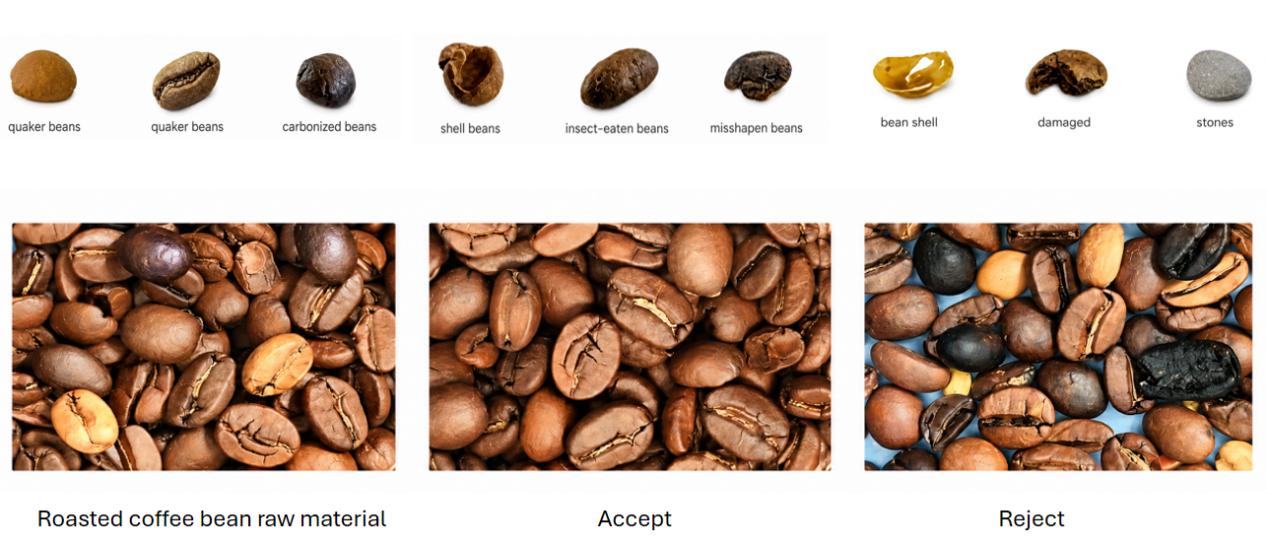
Typical post-roast quality concerns include:
Quaker beans with lighter-than-normal appearance
Uneven roast color within the same batch
Over-roasted or carbonized beans
Broken or damaged beans
Foreign materials and non-coffee particles
For whole-bean coffee products, appearance is an important part of customer expectations and brand presentation.
Post-roast sorting serves as a final verification checkpoint before packaging, helping manufacturers separate abnormal beans while preserving acceptable products.
Quaker Beans: A Key Challenge in Specialty Coffee
Quaker beans are among the most recognized quality challenges in roasted coffee production.
Quaker beans are underdeveloped coffee beans that lack sufficient sugar development to complete normal browning reactions during roasting, resulting in a noticeably lighter appearance than properly roasted beans.
Although green coffee sorting can significantly reduce immature and defective beans before roasting, some quaker beans may still remain because certain quality differences become apparent only after roasting.
For specialty coffee roasters, quaker beans are a concern because they can affect both visual uniformity and cup quality. They may contribute undesirable sensory characteristics such as:
Grassy or underdeveloped notes
Astringency
Reduced sweetness
Less balanced flavor expression
For this reason, quaker detection has become an important part of post-roast quality control.
Roast Color Variations and Uneven Roasting Results
Roasting transforms the physical and chemical characteristics of coffee beans. Differences in bean properties, roasting conditions, or heat distribution can result in uneven color development within the same batch.
Common roast-related variations include:
Light-colored beans caused by insufficient roast development
Over-roasted or excessively dark beans
Carbonized beans with abnormal appearance
Uneven roast color distribution
For whole-bean coffee products, consumers and retailers generally expect a uniform appearance across different batches.
Identifying roast-color outliers after roasting helps coffee manufacturers improve the visual consistency of finished products before packaging.
Physical Defects and Foreign Materials
Beyond roast-related appearance differences, roasted coffee may also contain physical defects or unwanted materials that affect product presentation and processing quality.
Common concerns include:
Broken or chipped beans
Damaged coffee beans
Bean fragments
Stones or other non-coffee materials
Roasting reduces moisture content and makes coffee beans more fragile during handling. As a result, conveying and sorting conditions become important factors in protecting acceptable beans throughout the production process.
The challenge for coffee processors is not only separating unwanted materials and defective beans, but also achieving accurate sorting while minimizing unnecessary product loss.
RaymanTech Roasted Coffee Bean Sorting Solution
After roasting, coffee producers need a reliable way to control visible defects, maintain product presentation, and protect finished product quality before packaging.
RaymanTech's optical sorting solutions for roasted coffee combine multi-view imaging, AI recognition, optional infrared inspection, gentle product handling, and hygienic design to address key post-roast quality challenges.
The system analyzes each bean using multiple characteristics, including:
Color
Shape
Surface appearance
Material-based spectral responses
Together, these technologies create a more reliable and repeatable sorting process for whole-bean coffee applications.
Multi-View Imaging for Better Coverage of Irregular Beans
Coffee beans naturally have curved surfaces and irregular shapes. A single viewing angle may not capture all visible characteristics of an individual bean, particularly when defects are located on partially hidden surfaces.
RaymanTech's multi-view imaging technology captures coffee beans from multiple directions, reducing blind spots caused by bean curvature and random orientation.
By providing more complete image data, the system gives AI recognition a stronger foundation for accurate defect classification.
AI Recognition for Subtle Appearance Differences
Roasted coffee defects are not always defined by simple color differences. Variations between beans can be subtle, especially across different roast profiles and natural product variations.
Using the complete image data captured through multi-view imaging, RaymanTech's AI recognition technology analyzes complex appearance patterns to distinguish acceptable beans from abnormal products.
Typical applications include:
Separating light-colored quaker beans
Detecting abnormal roast colors
Identifying damaged or inconsistent beans
Applying customer-defined sorting standards
Coffee producers can adjust inspection criteria according to product characteristics, roast style, and quality requirements.
Infrared Inspection for Material-Based Differences
Some foreign materials may appear similar to coffee beans under visible light but have different material characteristics.
RaymanTech's optional infrared inspection technology adds material-based information beyond visible appearance, helping identify certain foreign materials that may be difficult to distinguish through traditional visual inspection alone.
When combined with visible imaging, infrared inspection can assist in detecting materials such as:
Stones
Other non-coffee particles
This additional inspection capability provides another level of protection against foreign material contamination.
Designed for Coffee Processing Requirements
Gentle Product Handling for Roasted Coffee Applications
Roasted coffee beans become more fragile after roasting because moisture content is reduced and their internal structure changes.
During sorting and conveying, excessive mechanical impact may increase breakage and reduce the value of whole-bean products.
RaymanTech's sorting systems are designed with gentle product handling in mind to help protect acceptable beans throughout the inspection process.
Key benefits include:
Reduced unnecessary bean breakage
Better preservation of whole-bean appearance
Protection of finished product value
For premium whole-bean coffee products, preserving acceptable beans is just as important as removing defective ones.
Hygienic Design for Coffee Processing Environments
Coffee roasting and packaging facilities require equipment that supports food hygiene standards, reliable operation, and efficient maintenance.
RaymanTech's optical sorting systems feature a hygienic, IP66-rated, washdown-ready design suitable for modern food processing environments.
The design supports:
Easier cleaning and maintenance
Stable operation during continuous production
Integration into modern coffee processing lines
This allows manufacturers to strengthen quality control without adding unnecessary complexity to daily operations.
Flexible Solutions for Different Coffee Applications
Inspection priorities vary depending on the coffee product, roast profile, production environment, and defect standards. For example:
Specialty coffee roasters may prioritize quaker detection and roast appearance control
Packaged coffee manufacturers may focus on throughput and stable sorting performance
Different roast profiles may require different sorting criteria
RaymanTech works closely with coffee producers to evaluate product characteristics, defect priorities, and production conditions, developing inspection solutions tailored to each application.
Product sample testing allows manufacturers to evaluate sorting performance under actual production conditions before selecting the most suitable solution.
Building Consistent Quality for Roasted Coffee Brands
For coffee producers, post-roast inspection is more than a defect removal step. It is the final quality checkpoint before products move to packaging and distribution.
By combining multi-view imaging, AI recognition, optional infrared inspection, gentle product handling, and hygienic design, RaymanTech helps coffee producers build a more reliable, repeatable, and efficient post-roast quality control process.
The result is more consistent whole-bean products, reduced reliance on manual inspection, and greater confidence in outgoing product quality.
FAQ
What are quaker beans in roasted coffee?
Quaker beans are underdeveloped coffee seeds with lower sugar content. During roasting, they do not undergo the same browning reactions as normally developed beans, resulting in lighter-colored beans with different flavor characteristics.
Why are quaker beans easier to detect after roasting?
Quaker beans may be difficult to completely identify before roasting because their differences are not always visible in green coffee. After roasting, their lighter color becomes more noticeable compared with normally developed beans.
Can green coffee sorting completely eliminate quaker beans?
Green coffee sorting can reduce the number of defective beans before roasting, but it cannot completely eliminate quakers. Some defects only become visually distinguishable after roasting when differences in color development appear.
Where is optical sorting used in the roasted coffee production process?
For roasted coffee applications, optical sorting is typically installed after roasting and cooling, before packaging or final product handling. This creates a final inspection step for finished roasted beans.
Test Your Roasted Coffee Sorting Application
Every coffee product has different roast profiles, defect standards, and sorting requirements.
RaymanTech provides application-specific testing to evaluate quaker detection, roast-color variation, foreign material separation, and sorting performance using your actual coffee samples.
Contact RaymanTech to discuss your roasted coffee inspection requirements and explore a suitable optical sorting solution for your production line.

Related Articles
-
 Aug-11-2026
What Makes Dairy X-ray Inspection the Top Choice for Quality Control?
An in-depth look at why X-ray inspection is the preferred method for dairy quality control, covering contaminant detection, fill level verification, seal integrity checks, and the advantages of AI-powered systems for milk, cheese, and yogurt processing.learn more -
 Aug-11-2026
How AI Optical Sorting Delivers Value for Food Processors
AI optical sorting goes beyond accuracy: faster commissioning, easier product changeovers, stable inspection and long-term value for food processors.learn more -
Aug-11-2026
What Is a High Speed Sorting Machine and How Does It Boost Efficiency?
This article explains how high speed sorting machines work, their key efficiency gains across industries like meat, seafood, grains, and pharmaceuticals, and how to choose the right system for your production line.learn more




Follow us:
