 English EN
 Germany DE
 French FR
 Portuguese PT
 Spanish ES
.webp)
.webp)
Peanuts Optical and X-Ray Sorting Technologies
For processors, the challenge is evolving. It is n...
More

Seafood businesses increasingly invest in advanced shrimp sorting machine models to streamline grading. Rising labor costs and a shortage of skilled workers drive automation. The US automatic shrimp grading machine market is projected to reach $19.18 billion by 2033, growing at a CAGR of 13.76%.
| Market Segment | Value | Growth Rate |
|---|---|---|
| US Automatic Shrimp Grading Machine Market | $8.85 billion (2025) | CAGR of 13.76% (2026–2033) |
| Projected Market Value | $19.18 billion (2033) | - |
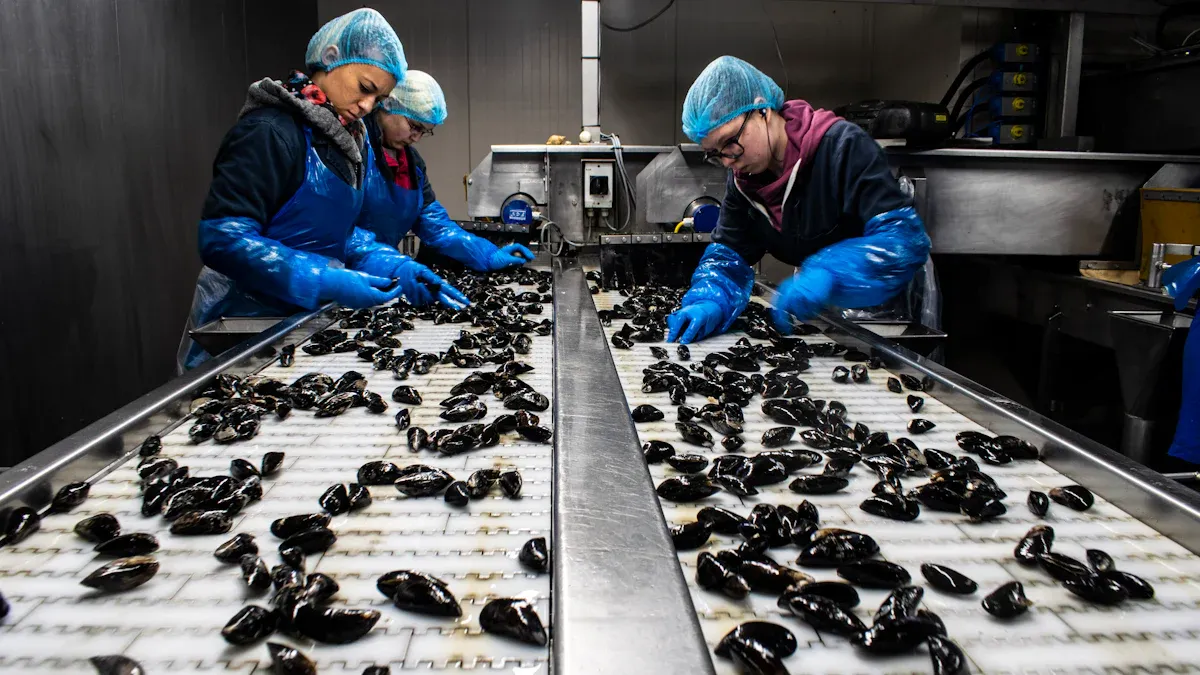
Selecting the right shrimp sorting machine depends on several technical features that directly impact grading efficiency. Industry experts highlight the following as most important:
| Feature | Description |
|---|---|
| Roller Adjustment | Automatic roller spacing adjustment provides fast changeovers between size grades. |
| PLC & Touchscreen Controls | User-friendly touchscreens allow operators to set grades, adjust speeds, and track output. |
| Hygienic Design | Stainless steel construction and easy-access panels support thorough cleaning and food safety. |
| Data Logging & Traceability | Integrated systems log batch sizes and grades, connecting to ERP systems for full traceability. |
| Vision and AI Sorting | Advanced cameras and AI detect size, color, and subtle defects, improving sorting accuracy. |
A shrimp sorting machine with these features enables processors to achieve consistent results, reduce manual intervention, and maintain high food safety standards.
Small seafood businesses often prioritize cost-effectiveness and simplicity. They benefit from compact machines that offer easy operation and maintenance. These models suit lower production volumes and limited budgets. In contrast, large operations require automated systems to handle high throughput and minimize human error. Automation not only increases efficiency but also reduces labor costs and waste. Over time, investing in advanced sorting technology leads to significant savings for larger businesses. The right choice depends on production scale, desired automation level, and long-term operational goals.
The Kerian Sizer stands out as a reliable solution for small seafood processors. This machine uses a series of adjustable rollers to separate shrimp by size with impressive accuracy. Operators can quickly change the roller spacing to accommodate different grading requirements. The compact design fits well in limited spaces, making it ideal for small facilities.
Kerian Sizer models offer straightforward controls. Most units feature stainless steel construction, which ensures durability and easy cleaning. Maintenance tasks require minimal downtime, and operators can learn the system quickly. The Kerian Sizer handles a range of shrimp sizes, but it works best with farmed varieties that have consistent shapes.
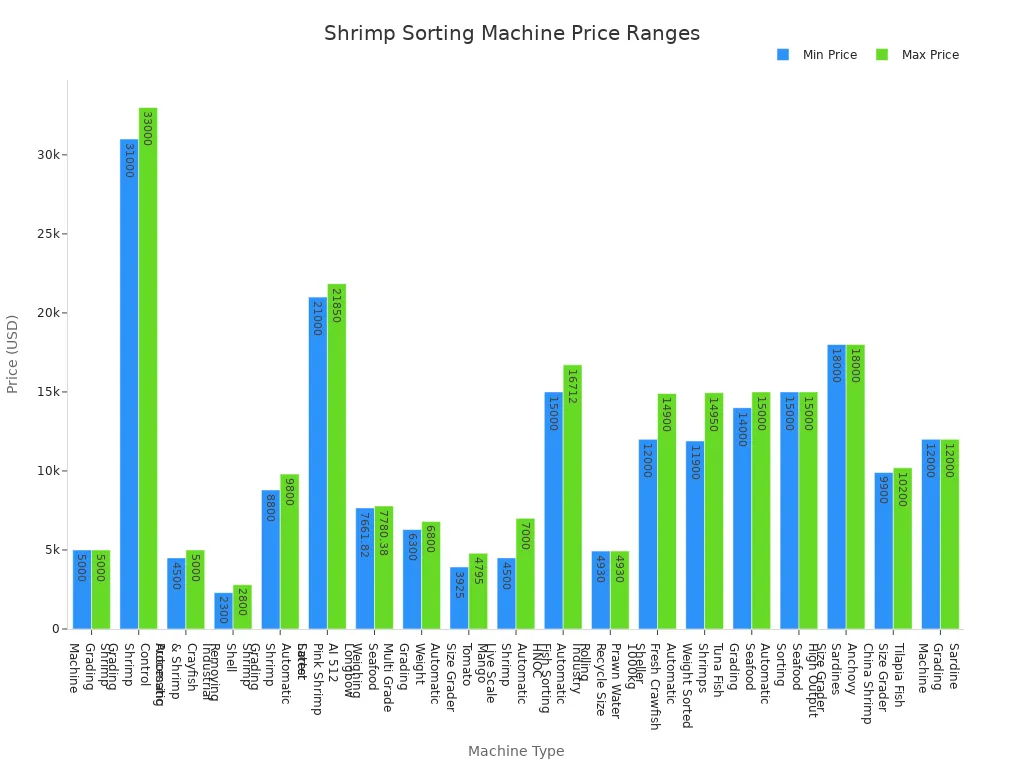
Pricing for entry-level shrimp graders like the Kerian Sizer starts around $5,000. More advanced automatic control models can reach $31,000 or higher. The following table summarizes price ranges for machines suitable for small seafood businesses:
| Machine Type | Price Range (USD) | Minimum Order |
|---|---|---|
| Shrimp Grading Machine | $5,000 | 1 set |
| Automatic Control Shrimp Grading Machine | $31,000 - $33,000 | 1 set |
| Industrial Crayfish & Shrimp Processing Machine | $4,500 - $5,000 | 1 set |
| Latest Automatic Shrimp Grading Machine | $8,800 - $9,800 | 1 set |
| Multi Grade Seafood Weighing Machine | $7,661.82 - $7,780.38 | 1 set |
The Kerian Sizer improves product uniformity and helps small businesses meet buyer specifications. Many processors report faster packaging and shipping timelines after installation.
The Martak Shrimp Grading System offers another strong option for small-scale operations. This machine uses a combination of rollers and belts to sort shrimp by size. The system supports multiple grading bands, which allows processors to create several product categories in one pass.
Martak’s design emphasizes hygiene and food safety. Stainless steel frames and easy-access panels simplify cleaning. The system integrates with data logging tools, which helps businesses track batch sizes and maintain traceability.
However, users often face several challenges:
High capital requirements
Securing regulatory approvals
Ensuring raw material supply
Competition from other processors
Skilled manpower availability
Managing operational risks
Despite these challenges, the Martak Shrimp Grading System remains popular among regional processors. For example, a seafood company in South America reported a 15% productivity increase after installing a compact Martak peeler. This improvement allowed them to expand their customer base without a major capital investment.
Small seafood businesses must weigh the advantages and limitations of each shrimp sorting machine. The table below summarizes the main points for the Kerian Sizer and Martak Shrimp Grading System:
| Advantages of Using a Shrimp Grader | Limitations and Challenges |
|---|---|
| Improves product uniformity and brand reputation | High initial capital outlay, particularly for smart grading systems |
| Reduces dependency on temporary labor | Potential downtime due to mechanical failure or calibration drift |
| Speeds up packaging and shipping timelines | Training required for operators and maintenance staff |
| Enhances compliance with buyer specifications | Not all models handle delicate or irregularly shaped shrimp well |
| Lowers risk of mislabeling penalties |
Shrimp graders deliver the most value when daily processing volumes exceed one ton. For very small operations handling less than 100 kg per day, the return on investment may take years unless labor costs are exceptionally high.
Small businesses benefit most from compact shrimp sorting machines in these scenarios:
When they need to increase productivity without hiring more staff
When they want to expand their customer base with consistent product quality
When they must comply with strict buyer specifications
Tip: Small processors should consider both the initial investment and ongoing maintenance costs. Choosing a machine with user-friendly controls and local support can reduce downtime and training expenses.
Large seafood processors often choose the SMART Sorter by Laitram Machinery for its advanced automation and high throughput. This shrimp sorting machine uses precision engineering to deliver accurate grading at speeds that meet industrial demands. Operators benefit from a user-friendly interface that allows quick setup and real-time monitoring. The SMART Sorter supports integration with conveyor systems, enabling seamless feed and discharge of shrimp.
The following table highlights the main features and benefits of the SMART Sorter:
| Feature | Benefit |
|---|---|
| High Precision | Accurate sorting capabilities to meet exacting standards. |
| Increased Throughput | High-speed processing to handle large volumes efficiently. |
| User-Friendly Interface | Easy-to-use controls for quick setup and operation and real-time data. |
Processors report significant operational cost savings with this machine. Many businesses save between $0.05 and $0.012 per pound, depending on the product graded. Some operations achieve even higher savings, which improves profitability and supports investment in further automation.
Carsoe offers another robust solution for large-scale shrimp grading. This machine features stainless steel construction and supports multiple sorting lanes. Operators can grade shrimp by size or weight, with options for two to six lanes. The Carsoe system integrates with conveyor feeds, which streamlines the sorting and packaging process. Many processors use Carsoe machines to handle both raw and cooked shrimp, as well as other seafood products.
The table below summarizes the capacity and automation specifications common to large-scale shrimp sorting machines:
| Capacity | Sorting Types | Number of Grades | Material | Integration |
|---|---|---|---|---|
| 1–50 tons/hour | Size, weight | 2–6 lanes | 304 stainless steel | Conveyor feed & discharge |
Carsoe machines suit businesses that require flexibility and durability. The stainless steel design ensures compliance with food safety standards and supports easy cleaning. Many operators appreciate the ability to adjust grades and lanes based on production needs.
The gap-drop system represents a classic approach to high-capacity shrimp sorting. This method uses a bed of upwardly rotating rollers. Shrimp align over gaps between the rollers, which increase in size along the length of the machine. Smaller shrimp fall through first, followed by larger ones. Water sprayers lubricate the shrimp's passage, reducing damage and improving flow. Movable baffles allow operators to fine-tune the grading points for greater accuracy.
The gap-drop system operates in four main steps:
Shrimp are placed on a bed of upwardly rotating rollers that align them over gaps between the rollers.
The gaps between the rollers increase progressively, allowing smaller shrimp to fall through first, followed by larger ones.
Water sprayers lubricate the shrimp's passage over the rollers.
Movable baffles can be adjusted at points where shrimp grades change for fine-tuning.
Processors value the gap-drop system for its reliability and ability to handle large volumes. Many facilities use this method to sort shrimp quickly and efficiently, especially when product uniformity is critical.
Large seafood businesses must evaluate the strengths and limitations of each shrimp sorting machine before investing. The following table outlines which machine types suit different business scales and applications:
| Machine Type | Suitable Business Scale | Applications |
|---|---|---|
| High Speed Weighing and Sorting Machine | Medium and Large Scale | Handling shrimp (with/without head), shrimp meat, cooked shrimp, and various fishes |
Pros of advanced shrimp sorting machines:
High throughput supports processing up to 50 tons per hour.
Automated grading reduces labor costs and human error.
Stainless steel construction ensures hygiene and durability.
Integration with conveyor systems streamlines workflow.
Cons to consider:
High initial investment may challenge smaller processors.
Complex systems require skilled operators and regular maintenance.
Downtime during calibration or repairs can disrupt production schedules.
Tip: Large processors should match machine specifications to their product mix and production targets. Investing in a shrimp sorting machine with flexible grading options and robust support services can maximize efficiency and long-term returns.

Choosing the right shrimp sorting machine depends on business size, production goals, and available resources. Small and large seafood processors face different challenges and require unique solutions. The table below highlights the main differences between models designed for each business type:
| Feature | Small Business Models | Large Business Models |
|---|---|---|
| Capacity | Up to 1 ton/hour | 10–50 tons/hour |
| Footprint | Compact, fits small spaces | Large, requires dedicated area |
| Automation Level | Manual or semi-automatic | Fully automated, advanced controls |
| Price Range | $5,000–$33,000 | $50,000 and above |
| Maintenance | Simple, low-cost | Requires skilled technicians |
| Integration | Standalone operation | Integrates with conveyors and ERP |
| Best For | Startups, small processors | Industrial-scale operations |
Small business models focus on affordability and ease of use. Operators can quickly learn to run these machines. Maintenance remains straightforward, which reduces downtime.
Large business models deliver high throughput and advanced automation. These machines support integration with other processing equipment. They require skilled staff for operation and maintenance.
Tip: Companies should assess their current and future production needs before investing in a shrimp sorting machine. A scalable solution can support business growth and changing market demands.
Selecting the ideal shrimp sorting machine requires careful evaluation of operational priorities. Seafood processors should compare essential factors before making a purchase. The table below outlines the most important considerations:
| Factor | Description |
|---|---|
| Industry Compliance | Meets food contact and corrosion-resistant material standards. |
| Cost-Efficiency | Considers total ownership costs, including energy and maintenance labor. |
| Quality Assurance | Features automated calibration and self-diagnostics for traceability. |
| Integration Capabilities | Compatible with upstream and downstream equipment for efficient processing lines. |
| After-Sales Support | Offers responsive service and operator training programs. |
Processors should also:
Match machine capacity and grading accuracy to their operation size.
Prioritize models with adjustable sieve or roller settings.
Choose durable stainless steel construction for longevity.
Ensure easy sanitation access to maintain hygiene.
Automated sorting systems increase grading efficiency and product uniformity. These machines reduce manual labor, minimize waste, and help seafood businesses meet customer expectations.
Routine maintenance and reliable support extend the lifespan of any shrimp sorting machine. Facilities should:
Schedule regular cleaning and calibration of rollers or sensors.
Inspect moving parts to prevent breakdowns.
Use machines with food-grade stainless steel and smooth surfaces for easy sanitation.
Select equipment that is easy to disassemble for thorough cleaning.
Support from manufacturers plays a critical role. Companies should:
Inquire about warranty terms and technical support availability.
Confirm the supplier’s inventory of spare parts.
Evaluate training programs for operators and technicians.
Check average response times for service requests.
Tip: A strong after-sales support network and comprehensive training can reduce downtime and ensure consistent product quality.
Seafood processors achieve the best results by selecting the right shrimp sorting machine for their scale. Compact models like the Kerian Sizer and Martak system suit small businesses, while automated, high-capacity machines such as the SMART Sorter, Carsoe, and gap-drop systems maximize efficiency for large operations.
| Trend | Description |
|---|---|
| Automation | Enhances efficiency in shrimp processing. |
| AI and Machine Learning | Improves sorting accuracy and operational efficiency. |
| Sustainability | Drives innovation in shrimp sorting technologies. |
| Market Growth | Seafood demand fuels an 8.3% CAGR from 2026 to 2033. |
Processors should assess business size, budget, and support needs to ensure easy grading and increased profitability.
Operators should clean rollers, check moving parts, and calibrate sensors regularly. Routine inspections help prevent breakdowns and ensure consistent grading performance.
Automated machines increase throughput, reduce labor costs, and deliver consistent grading accuracy. They also minimize human error and support traceability in seafood processing.
Most modern machines feature adjustable settings. Operators can grade various shrimp sizes and species by changing roller gaps or programming new parameters.

We provide you with comprehensive foreign trade solutions to help enterprises achieve global development
.webp)
Designed for food manufacturers requiring exceptio...
Chicken bone inspection, global poultry AI databas...
.webp)
Automatic recognition and rejection, fish bone ins...
.webp)
Glass-in-glass / Metal-in-metal inspection, small ...
Select the most popular foreign trade service products to meet your diverse needs
Select the most popular foreign trade service products to meet your diverse needs







User Comments
Service Experience Sharing from Real Customers
Michael Rodriguez
Production ManagerThis shrimp sorting machine has revolutionized our processing line. The accuracy and speed are phenomenal, significantly reducing labor costs and waste. A game-changer for our seafood plant.
Sarah Chen
Quality Assurance SupervisorVery impressed with the machine's consistency in grading by size and color. It's highly reliable and has improved our overall product quality. Minor software interface could be more intuitive, but overall an excellent investment.
James Wilson
Aquaculture Farm OwnerAs a farm owner, integrating this sorter into our harvest process was the best decision. It handles our fresh shrimp gently and sorts with precision we could never achieve manually. Customer satisfaction has noticeably increased.
Lisa Thompson
Operations DirectorOutstanding performance and durability. The machine runs 16 hours a day with minimal downtime. The technical support team is also very responsive. It has paid for itself in efficiency gains within the first year.