
 English EN
 Germany DE
 French FR
 Portuguese PT
 Spanish ES
Beyond the Basics: A Professional Guide to Almond Sorting Technology
In the almond industry, quality is non-negotiable. Processors face a complex challenge: removing not only obvious foreign matter but also subtle product defects, internal damage, and micro-impurities. A single sorting machine is no longer the answer. Today, success demands an integrated, full-process strategy.
This guide explores the professional-grade inspection and sorting solutions from RaymanTech, following our proven "Whole Chain Solution" logic—from raw material to packaged goods.
1. The Core Problem: Almond Sorting Requirements
Effective sorting begins with defining the targets. The requirements differ for bulk and packaged products.
· Shelled Almonds: Must separate thick from thin shells and reject green peel, mildew, and insect-eaten nuts.
· Almond Kernels: Requires sorting a wide range of defects, including mold, double kernels, mechanical damage, breaks, shriveled kernels, and even fine hair.
·Packaged Almonds: Final inspection for any foreign matter or product defects before shipping.
2. Foundational Technology: Key Equipment Comparisons
Choosing the right technology is the most critical decision. The primary trade-offs are between chute and belt sorters, and between optical sorters and X-ray systems.
Color Sorter vs. X-Ray Inspection System
· Color Sorter (Optical):
· Uses visible light technology.
·Inspects surface differences only.
· Excels at finding surface-level insect damage or creases but cannot identify internal defects.
· X-Ray Inspection System:
· Uses penetrating X-Ray technology.
·Detects internal defects, such as insect damage hidden from the eye.
· Essential for detecting foreign matter like plastic, glass, and metal.
Chute Color Sorter vs. Belt Color Sorter
· Chute Color Sorter:
· Identifies subtle color differences and obvious shape differences.
· Lacks deep learning intelligent algorithms.
· Effective for primary sorting of defects like mildew or different colors.
· Belt Color Sorter:
· Features a deep learning intelligent algorithm.
· Capable of identifying both subtle color AND subtle shape differences.
· The clear choice for all almond types (raw, roasted, fried) and is designed to replace manual labor for complex sorting tasks.
Conclusion: For a complete solution, optical and X-ray technologies must be combined. RaymanTech’s Combo X-Ray and Visual Inspection System integrates both, detecting internal and external defects simultaneously.
3. Core Solutions for Bulk Almond Sorting
RaymanTech has engineered a suite of machines to address every bulk sorting scenario.
AI-Powered Belt Color Sorters
Our intelligent belt sorters are the nucleus of a modern sorting line.
· AI Deep Learning: This is more than just sorting. It is an intelligent process that learns your product. It can be trained to identify "malignant impurities" like glass, buttons, or cigarette butts, replacing high-cost, high-error manual sorting.
· Double Layer Sorter: This high-capacity design (2.5-4t/h) allows for sorting on the upper layer and re-sorting on the lower layer, maximizing output and purity while minimizing good-product rejection.
· Medium Speed Visual Sorter: Specifically designed for fragile, high-value products like roasted or fried almonds.
· Anti-Breakage Structure: Utilizes an elastic buffer layer (silicone curtain) and silicone-skinned dividers to reduce impact and friction, protecting the product.
· Micro-Impurity Detection: Features ultra-high-definition imaging capable of recognizing and ejecting very fine impurities, including hair.
Advanced X-Ray Inspection for Bulk
For ultimate safety, X-ray inspection is essential.
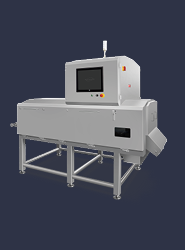
· X-Ray Inspection Machine for Bulk: This system is critical for finding internal insect erosion (wormholes) in both shelled almonds and kernels. It reliably detects all types of foreign bodies like metal, glass, and plastic.
· Core Tech: Dual-Energy X-Ray: RaymanTech’s innovative dual-energy detector is highly recommended for uneven and stacked products like almonds. It acquires two images at different energy levels to differentiate materials, removing the background "noise" from product thickness. This makes it exceptionally effective at finding low-density foreign objects (PVC, silicon, etc.) that standard X-rays miss.
4. Final Assurance: Packaged Almond Inspection
The sorting process does not end until the product is sealed. RaymanTech's end-of-line systems provide a final quality gate.
· X-Ray Inspection for Packaged Products: Inspects finished bags and pouches for any contaminants, metal or non-metal, inside the packaging.
· Metal Detector: Uses advanced digital signal processing and self-balancing technology for stable, highly sensitive detection of metal contaminants.
· Checkweigher: A high-speed, high-stability dynamic weight checker that ensures every package meets its labeled weight, with accuracy up to ±0.1g for small packages.
By integrating these technologies—from AI-powered optical sorting to dual-energy X-ray and end-of-line checks—RaymanTech delivers a robust, intelligent, and complete sorting solution for the entire almond processing chain.
_1.png)
Related Articles
-
 Nov-20-2025
RaymanTech Bulk X-ray Inspection:The First and Most Important Line of Defense in Food Safety
In food processing, the highest-risk moment isn’t at the final packing station—it’s the second a truck backs up to the silo and unloads tons of raw nuts, grains, seeds, spices, dried fruit, coffee, or frozen vegetables. At that point, everything is mixed together: the good product you paid for, plus stones from the field, metal from harvesting equipment, glass from a broken bulb in the dryer, twigs, leaves, shells, insect-damaged kernels, moldy berries, and pieces of plastic baling twine.learn more -
 Nov-20-2025
RaymanTech Standard Dual Energy X-ray: Seeing the Invisible in Overlapped and Uneven Products
Picture a high-speed frozen broccoli line running at 60 meters per minute. Thousands of dark-green florets tumble straight from the IQF tunnel onto the belt. They overlap, fold, twist, and pile two or three deep. Some are still lightly coated with ice, others are perfectly dry. Hidden somewhere in that moving green avalanche is a sliver of blue plastic film, a tiny piece of rubber gasket, or a fragment of thinlearn more -
 Nov-20-2025
RaymanTech Dual Energy Residual Bone Detector: Absolute Bone Removal in Poultry Processing
Bone fragments are the poultry industry’s most persistent and expensive headache. Even the most advanced mechanical deboning systems leave behind collar bones, rib tips, fan bones, cartilage shards, and calcified tendon ends. These remnants are rarely metallic, often flexible, and almost impossible to see with the naked eye once the fillet is marinated, breaded, or frozen. Yet consumers notice them immediately—and one viral complaint can cost millions in lost contracts and brand damage.learn more




Follow us:
