
 English EN
 Germany DE
 French FR
 Portuguese PT
 Spanish ES
How Multi-View AI Sorting Helps Frozen French Fries Processors Improve Quality Control, Optimize Product Grading, and Maximize Raw Material Utilization
Every French Fry Matters: Smarter Sorting for Modern French Fries Production. For frozen French fries manufacturers, maintaining consistent product quality while maximizing raw material value is a continuous challenge.
Large-scale production requires processors to manage natural potato variations, strict customer specifications, and high-speed processing conditions. Even small differences in color, shape, size, or surface appearance can influence final product acceptance.
Modern French fries sorting is no longer only about removing defective products. Manufacturers increasingly need intelligent sorting solutions that can improve quality control, support product grading, and reduce unnecessary product loss.
AI optical sorting combines multi-view inspection, intelligent image recognition, and customized sorting strategies to help French fries processors make more accurate decisions based on their product requirements.
1. Why French Fries Sorting Is Challenging
1.1 Managing Natural Product Variations and Quality Consistency
Potatoes are agricultural products, and natural variations are unavoidable throughout the production process. Factors such as potato variety, growing conditions, and processing parameters can influence the final characteristics of French fries.
Common variations include:
Color differences
Size variations
Shape differences
Surface appearance changes
For suppliers serving foodservice customers, retail brands, and export markets, maintaining consistent product standards is essential.
Traditional inspection methods often rely heavily on operator experience. However, during long production runs, maintaining consistent judgment can be challenging, especially when product conditions change.
A more advanced sorting approach helps processors better manage product variation and maintain stable quality control.
1.2 Reducing Unnecessary Product Loss
One of the key challenges in French fries sorting is distinguishing between products with acceptable variations and products that truly need to be rejected. Not every fry that differs from premium appearance standards should become waste.
Some products may still:
Meet food safety requirements
Be suitable for consumption
Have commercial value
The challenge is creating clearer separation criteria based on customer requirements, product positioning, and sales channels.
A more precise sorting strategy helps processors reduce unnecessary rejection and improve raw material utilization.
1.3 Meeting High-Speed Production Requirements
Frozen French fries are typically produced through continuous, high-volume processing lines.
This creates additional sorting challenges:
Large product volumes
Continuous product movement
Different product orientations
Strict production efficiency requirements
For industrial-scale production, sorting performance needs to balance:
Quality standards
Processing speed
Product utilization
Production stability
The goal is not only to identify defects, but to achieve reliable sorting performance throughout the production process.
2. RaymanTech French Fries Sorting Application
2.1 Application Background
A frozen food processor supplying foodservice and retail customers required a more effective sorting approach for high-volume French fries production.
The company needed a solution that could:
Improve product quality consistency
Support clearer product grading
Reduce unnecessary product loss
Maintain efficient continuous production
The goal of this project was not simply to remove defective fries, but to establish a clearer product grading strategy while maintaining quality control and maximizing raw material utilization in continuous production.
2.2 Common Defects Identified in French Fries Sorting Applications
French fries sorting requires evaluation of multiple product characteristics, including color, surface condition, shape, size, and unwanted materials.
Typical sorting targets include:
Color and Appearance Defects
Black spots
Green ends
Greenish discoloration
Brown spots
Light brown discoloration
Scab defects
Burnt fries
Surface Defects and Processing Residues
Potato peel
Peel fragments
Shape and Specification Issues
Broken fries
Short fries
Length variations
Irregular shapes
Foreign Materials
Stones
Other unwanted materials
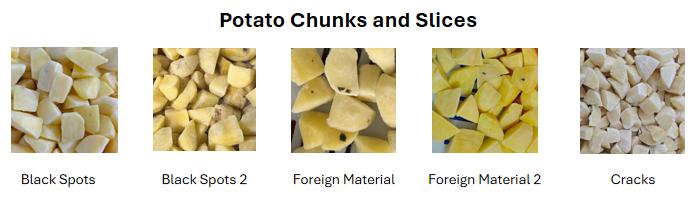
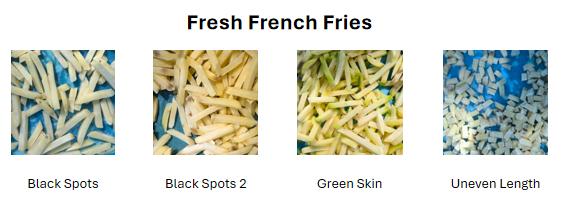
Different processors may define acceptance standards based on customer requirements, market positioning, and product applications. Therefore, sorting criteria should be customized according to actual product conditions and quality objectives.
2.3 Customized Sorting Strategy Based on Customer Requirements
For frozen French fries processors, product standards can vary depending on customer expectations, sales channels, and market positioning.
A successful sorting approach should not rely on a single fixed rejection rule. Instead, it should be developed based on:
Product requirements
Quality standards
Production objectives
Based on customer requirements, RaymanTech develops customized optical sorting solutions to help processors establish clearer product separation strategies. The sorting logic can help separate:
Premium Products
French fries that meet higher quality requirements, including:
Better appearance consistency
More stable size distribution
Overall product presentation suitable for higher-standard customers
Commercially Acceptable Products
French fries that:
Meet food safety requirements
Remain suitable for consumption
Do not meet the highest appearance standards
Depending on customer requirements and application scenarios, these products may still have commercial value.
Reject Products
Products with:
Unacceptable defects
Severe quality issues
Foreign material concerns
These products are removed before entering the final product stream.
By establishing sorting criteria according to customer requirements, RaymanTech helps processors:
Improve product separation
Reduce unnecessary rejection
Optimize raw material utilization
2.4 High-Speed Sorting and Rejection Performance
French fries present unique challenges for automated sorting because they are long, lightweight products moving continuously at high speed.
During production, fries may:
Change orientation on the conveyor
Overlap with other products
Present different visible surfaces
Therefore, an effective French fries sorting machine requires not only accurate inspection, but also fast and reliable rejection performance.
For high-volume French fries production, key sorting requirements include:
Rapid defect identification
Precise rejection timing
Stable product separation
Low carryover of acceptable products
RaymanTech optical sorting solutions are designed for continuous production environments, helping processors maintain reliable sorting performance under demanding operating conditions.
Depending on product characteristics, quality requirements, and equipment configuration, the solution can support processing capacities of approximately 6 tons per hour.
Actual performance depends on:
Product conditions
Sorting requirements
Production line configuration
Application conditions
3. Why Multi-View AI Sorting Fits French Fries Production
3.1 Multi-View Inspection for More Reliable Sorting Decisions
French fries are long-shaped products that may rotate or change position during transportation. A defect that is difficult to identify from one viewing angle may become clearer from another perspective.
Multi-view inspection captures more complete product information, helping the system evaluate:
Surface appearance
Shape differences
Localized defects
For French fries applications, more complete visual information supports more reliable sorting decisions in real production environments.
3.2 AI Classification Based on Product Requirements
French fries naturally contain variations in appearance, shape, and product condition.
AI-based recognition helps analyze product characteristics based on:
Defect types
Appearance differences
Customer quality standards
RaymanTech develops application-based AI sorting models supported by:
Food sample data
Defect recognition experience
Food sorting application knowledge
By combining AI recognition with customer-specific requirements, RaymanTech helps processors distinguish acceptable product variations from true quality defects and develop sorting strategies that better fit their production goals.
4. Business Value for French Fries Processors
4.1 Improve Yield and Raw Material Utilization
For French fries manufacturers, intelligent sorting is not only about removing defective products. It is also about making better use of available raw materials.
By applying customized sorting criteria, processors can better separate products according to their quality requirements and reduce unnecessary rejection.
This helps manufacturers:
Improve raw material utilization
Reduce avoidable product loss
Increase the value of processed products
4.2 Deliver More Consistent Quality to Customers
Foodservice customers, retail brands, and export markets often require stable product specifications and consistent appearance.
A reliable sorting process helps processors achieve:
More consistent outgoing product quality
Better compliance with customer requirements
More predictable quality management
This supports stronger customer confidence and helps manufacturers maintain long-term supply relationships.
4.3 Enable Smarter Food Manufacturing
Food manufacturers are increasingly moving from manual inspection toward automated and intelligent quality management.
The development path can be summarized as:
Manual inspection
↓
Automated sorting
↓
Intelligent quality management
AI optical sorting helps processors:
Reduce repetitive inspection tasks
Improve production stability
Support automated quality control
Build more flexible manufacturing processes
Rather than replacing operators, intelligent sorting helps employees reduce repetitive checking work and focus on higher-value production activities.
5. How to Evaluate a French Fries Sorting Solution Before Purchase
Before selecting a sorting system, processors should evaluate the solution based on actual product requirements and production conditions.
Product Requirements
Consider:
What defects need to be removed?
What quality standards need to be achieved?
Are different product grades required?
Sorting Capability
Consider:
Can the system handle natural product variations?
Is multi-view inspection suitable for the application?
Can sorting criteria be customized according to customer requirements?
Production Requirements
Consider:
Required processing capacity
Production environment
Integration with existing production lines
Product Testing
Product sample testing is an important step before equipment investment.
Testing helps verify sorting performance under actual product conditions and provides a clearer understanding of application suitability before final equipment selection.
Frequently Asked Questions
1. What defects can AI optical sorting detect in French fries?
AI optical sorting can help identify appearance and quality variations such as dark spots, discoloration, shape defects, and other unwanted materials depending on product conditions and sorting requirements.
2. Can optical sorting help improve French fries yield and reduce waste?
Yes. By separating acceptable products from true defects, intelligent sorting can help reduce unnecessary product loss and improve raw material utilization.
3. How does a French fries sorting machine handle high-speed production?
French fries sorting systems are designed for continuous production environments. Actual performance depends on product characteristics, sorting requirements, and equipment configuration.
4. Is product sample testing needed before selecting a French fries sorting system?
Yes. Sample testing helps evaluate application suitability and verify sorting performance under actual product conditions before investment.
Conclusion
Smarter Sorting for More Consistent French Fries Production
As frozen French fries production becomes more standardized and customer requirements continue to increase, reliable sorting plays an important role in maintaining product quality and maximizing product value.
With AI recognition, multi-view inspection, and customized sorting strategies, RaymanTech helps processors develop sorting solutions based on their specific product requirements and production conditions.
Evaluate Your French Fries Sorting Requirements with RaymanTech
Every frozen food application has different quality standards and production challenges.
RaymanTech can evaluate your French fries application and discuss a suitable sorting approach based on your product characteristics and quality requirements.
Contact RaymanTech to discuss your French fries sorting requirements, or arrange a product sample test with your own samples to evaluate sorting performance under real production conditions.

Related Articles
-
 Jul-27-2026
What Is the Best Biscuit X-ray Machine for Food Safety?
A practical guide to choosing the best biscuit X-ray machine for food safety, covering bulk inspection, packaged product scanning, and jar or tin detection with AI and dual-energy technology.learn more -
.webp) Jul-27-2026
Jul-27-2026Almond Kernel Sorting: AI Optical Sorter & X-Ray Inspection
How multi-view AI optical sorting and X-ray inspection help almond processors detect hidden insect damage, grade kernels and protect product value.learn more -
 Jul-27-2026
What Is a High Speed Sorting Machine and How Does It Boost Efficiency?
This article explains how high speed sorting machines work, their key efficiency gains across industries like meat, seafood, grains, and pharmaceuticals, and how to choose the right system for your production line.learn more




Follow us:


