
 English EN
 Germany DE
 French FR
 Portuguese PT
 Spanish ES
IQF Frozen Carrot Sorting Solution for Color Defect Detection, Specification Control, and Foreign Material Removal
IQF (Individually Quick Frozen) carrot products are widely used in retail, foodservice, and food manufacturing. Common formats include carrot slices, diced carrots, carrot chunks, carrot strips, and other cut formats.
Before packaging, processors need to remove unacceptable carrot pieces, foreign materials, and off-spec product while keeping acceptable product within specification. In frozen carrot processing, the objective is not simply to reject every unusual-looking piece, but to separate reject-level defects from acceptable product according to product specifications and sorting criteria.
An effective IQF frozen carrot sorting system therefore needs to evaluate color, size and shape, visible processing defects, and foreign materials while keeping pace with continuous frozen food production.
IQF Frozen Carrot Sorting at a Glance
Key Takeaway: In IQF frozen carrot processing, post-freezing optical sorting provides a final inspection checkpoint for separating off-color units, damaged pieces, off-spec cuts, trimming defects, and foreign materials before packaging.
Why IQF Frozen Carrots Need Automated Sorting
By the time frozen carrots reach the final inspection point, visible quality differences may still remain in the product stream. These may include discoloration, misshapen cuts, trimming defects, surface blemishes, breakage, or foreign materials.
Manual inspection becomes difficult when product moves continuously at high line speeds and acceptable natural variation still needs to be distinguished from reject-level defects.
Automated optical sorting applies defined inspection criteria consistently across the product stream, helping processors improve final inspection before packaging.
Common Quality Challenges in IQF Frozen Carrot Products
Frozen carrot defects can originate from the raw material, peeling, trimming, cutting, blanching, conveying, freezing, or subsequent handling.
A practical sorting system needs to distinguish normal product variation from conditions that affect appearance, specification compliance, or finished-pack consistency.
1. Color Defects and Discoloration
Color is one of the most important visible quality factors in IQF frozen carrots.
Common conditions of concern may include:
Green units
White units
Orange-brown off-color units
Abnormally dull or discolored pieces
Some color variation is natural, but excessive discoloration can affect finished-pack appearance, product consistency, and customer acceptance.
For optical sorting, the key task is to distinguish acceptable natural color variation from off-color characteristics that fall outside the processor's sorting criteria.
2. Size, Shape, and Misshapen Product
Depending on the product format, processors may need to control:
Oversized or undersized pieces
Irregular or misshapen pieces
Non-uniform slices or dices
Excessively small pieces
Off-spec shapes for the intended cut style
Not every variation is automatically a defect. However, excessive deviation from the intended format can affect product appearance, portion consistency, cooking consistency, and specification compliance.
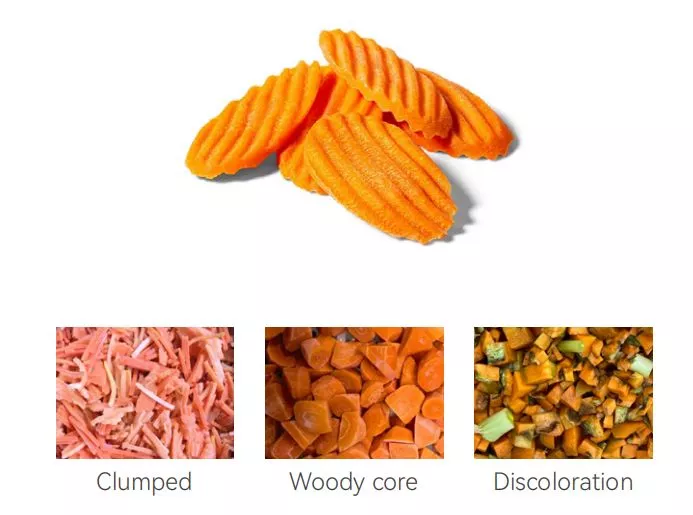
In some applications, processors may also classify lignified or excessively fibrous carrot pieces as off-spec when these conditions create visible differences in appearance or cut quality.
Note: Optical sorting is primarily concerned with visible characteristics. Whether a lignified or fibrous condition can be detected depends on how clearly it is expressed on the product surface or exposed cut area.
3. Broken, Cracked, Damaged, and Clumped Product
Mechanical damage can occur during raw material handling, peeling, cutting, conveying, freezing, or subsequent handling.
Visible product issues may include:
Broken pieces
Cracked units
Crushed product
Frayed edges or damaged surfaces
Clumping or pieces sticking together during product handling and freezing
These conditions can affect finished-pack appearance, downstream handling, and the amount of off-spec product reaching final packaging.
4. Unpeeled Areas and Poorly Trimmed Pieces
Peeling and trimming quality directly affect the appearance of frozen carrot products. Depending on the process and customer requirements, visible peel remaining on the product or excessive trimming irregularities may be considered unacceptable.
Processors may need to remove:
Pieces with visible peel remaining
Poorly trimmed carrot units
Pieces with incomplete trimming or preparation
These defects are particularly relevant for products where visual consistency and finished-pack appearance are important.
5. Blemished Pieces and Dark Surface Defects
Frozen carrot products may also contain visibly blemished pieces affected by:
Brown or black external discoloration
Brown or black internal discoloration visible on the cut surface
Surface defects that materially affect appearance
The severity of a blemish can depend on its size, location, visibility, and the processor's product specification.
Optical sorting can help separate visibly affected pieces when the defect is exposed and detectable in the presented product view.
6. Foreign Materials and Extraneous Plant Material (EVM)
Foreign material control is another important part of IQF carrot inspection before packaging.
Depending on harvesting, transportation, and processing conditions, the product stream may contain:
Stones
Plastic fragments
Glass
Sticks
Field debris
Leaves and stems
Other extraneous plant material (EVM)
Some non-product materials differ clearly from carrot pieces, while others may be more difficult to separate because of similar size, shape, or color.
A robust optical sorting system should therefore be evaluated against the actual foreign materials and EVM present in the processor's product stream.
Product Presentation Challenges in IQF Lines
Even when the product itself is acceptable, inspection can still be affected by how frozen pieces are presented on the line.
IQF carrot pieces may:
Rotate during conveying
Partially overlap
Arrive in small clusters
Show variable visible surface area
These conditions do not necessarily make the product defective, but they can reduce inspection coverage when product is viewed from only one direction.
For this reason, product presentation is an important inspection challenge in frozen carrot sorting.
Why Manual Inspection and Basic Visual Sorting Are Often Not Enough
Manual inspection still plays a role in food quality control, but it becomes less consistent when product volume is high and sorting decisions must be made continuously.
In IQF carrot processing, operators may face:
High line speeds
Repetitive visual decision-making
Natural variation between acceptable pieces
Small defects on irregularly shaped products
Inconsistent product orientation on the conveyor
A basic single-view sorting system can also have limitations when product overlap, changing orientation, or mixed defect types are present.
The best sorting result is not maximum rejection. It is accurate separation based on defined quality criteria, with as little unnecessary loss of acceptable product as possible.
RaymanTech IQF Frozen Carrot Sorting Solution
RaymanTech provides AI optical sorting solutions for IQF frozen carrots, helping processors improve defect separation, specification consistency, and foreign material control before final packaging.
Rather than relying only on simple threshold-based comparison, the system can be configured to evaluate multiple visible product characteristics under real production conditions.
The objective is to remove products and materials outside the defined sorting criteria while preserving acceptable product.
AI-Based Classification for More Accurate Sorting Decisions
Frozen carrots naturally vary in color, shape, and cut presentation. Because of this, fixed sorting thresholds do not always provide the desired separation between acceptable variation and reject-level conditions.
AI-based classification analyzes multiple visible product characteristics and applies customer-defined sorting criteria to distinguish:
Acceptable color variation vs. off-color defects
Normal cut variation vs. off-spec size and shape
Usable product vs. damaged, blemished, or misshapen pieces
Carrot product vs. unwanted material
This is especially useful when processors need more precise separation decisions rather than simply removing every unusual-looking piece.
Reducing false rejects is an important part of yield optimization in frozen carrot sorting. Better classification can help preserve saleable product while still removing pieces that fall outside specification.
Multi-View Imaging for Irregular and Overlapping Carrot Pieces
IQF carrot slices, dices, and chunks do not move through a sorting line in one fixed orientation. Pieces can rotate, tilt, overlap, or partially cover one another, limiting what a single viewing angle can capture.
RaymanTech multi-view imaging captures product information from multiple directions, increasing visual coverage and reducing blind spots caused by irregular presentation.
This provides more complete image information for defect visibility and foreign material separation, particularly when IQF pieces cannot be consistently presented in one orientation.
High-Throughput Sorting for Continuous Frozen Vegetable Production
Frozen vegetable processors need inspection systems that can keep pace with production without becoming a bottleneck.
Depending on the application, RaymanTech belt-based optical sorting platforms can support speeds of up to 240 m/min for high-throughput applications.
Actual operating speed depends on factors such as:
Product size
Loading density
Defect specification
Required sorting accuracy
Product presentation
For processors, the key question is not the maximum reference speed alone, but whether the sorter can maintain the required inspection performance at the target line throughput.
Hygienic Design for Frozen Food Processing Environments
IQF carrot processing involves moisture, condensation, and regular washdown. Sorting equipment must therefore meet the practical requirements of frozen food production environments.
RaymanTech sorting systems use a hygienic food-processing design with IP66-rated protection for washdown environments.
The equipment is designed for applications where cleaning access, durability, and stable operation are important.
One Sorting Platform for Multiple IQF Vegetable Applications
Many frozen vegetable plants process more than one product type across different production runs.
A multi-application IQF vegetable sorting system can be configured for compatible products, depending on their physical characteristics and sorting requirements.
Potential applications include:
Carrot slices
Diced carrots
Carrot chunks
Peas
Green beans
Corn
Bell peppers
Other compatible IQF vegetable products
This gives processors greater flexibility when product schedules, cut styles, or customer requirements change.
FAQ
What defects can an IQF frozen carrot sorter detect?
Depending on the application, an IQF frozen carrot sorter can be configured to separate off-color units, broken or cracked pieces, poorly trimmed or unpeeled pieces, blemished carrot pieces, misshapen or off-spec cuts, foreign materials, and extraneous plant material (EVM). It can also support size and shape control for off-spec cuts.
Why is sorting performed after freezing?
Sorting after freezing creates a final quality checkpoint before packaging. At this stage, processors can inspect the finished IQF carrot product and remove visible defects or unwanted materials before shipment.
Is size and shape sorting important for frozen carrots?
Yes. Size and shape consistency are important quality requirements for frozen carrots and can affect product appearance, cooking consistency, portion consistency, and customer specifications.
Can AI sorting reduce false rejects?
Yes. AI-based classification can distinguish acceptable product variation from reject-level defects according to defined sorting criteria. This can help reduce unnecessary rejection of saleable product.
Can one sorting system handle other IQF vegetables?
Yes, in many cases. A multi-application optical sorting platform can be configured for compatible IQF vegetable products, depending on product characteristics and sorting requirements.
Test Your IQF Frozen Carrot Sorting Application
Carrot varieties, cut styles, defect limits, and production conditions can vary significantly from one processor to another.
RaymanTech provides application-specific testing using actual product samples to evaluate:
Color defect separation
Size and shape sorting
Visible defect removal
Foreign material detection
Multi-view inspection performance
Sorting performance at target throughput
Contact RaymanTech to discuss your IQF frozen carrot sorting requirements and evaluate a suitable optical sorting solution for your production line.




Follow us:
