
 English EN
 Germany DE
 French FR
 Portuguese PT
 Spanish ES
IQF Frozen Broccoli Sorting Solution: AI Optical and X-Ray Inspection
IQF (Individually Quick Frozen) broccoli is widely used in retail, foodservice, and food manufacturing. Common formats include broccoli florets, short spears, cut broccoli, chopped broccoli, and other processed formats.
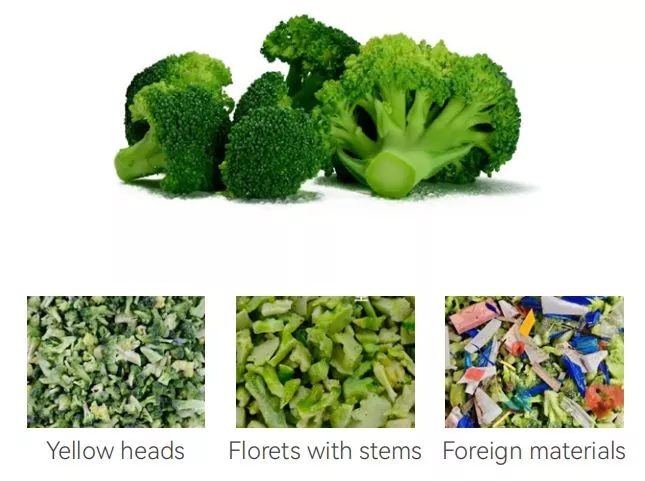
For processors, consistent quality means more than removing visibly defective pieces. Production lines may need to control color variation, blemishes, size and shape, damaged pieces, unwanted plant material, visible insects, and foreign materials while maintaining production throughput.
RaymanTech provides an integrated inspection solution combining AI optical sorting and X-Ray inspection for IQF frozen broccoli. Optical sorting focuses on visible product quality and unwanted material, while X-Ray adds another inspection layer for dense foreign materials that may be hidden or difficult to identify by appearance alone.
For frozen broccoli processors focused on product consistency and brand reputation, combining AI optical sorting with X-Ray inspection provides a practical way to control visible defects, reduce reliance on manual inspection, and establish a more repeatable quality control process.
Key Facts at a Glance
*Actual operating speed depends on product characteristics, loading, sorting criteria, and required inspection performance.
What Quality Challenges Does IQF Frozen Broccoli Face?
Frozen broccoli quality can vary throughout harvesting, trimming, cutting, processing, freezing, and handling. Product specifications also differ between processors, product formats, and customers.
Common inspection targets include:
Color and brightness variation
Visible blemishes and discoloration
Size and shape variation
Broken or damaged pieces
Loose leaves and unwanted plant material
Visible insects
Filamentous foreign material
Dense foreign materials
The goal is not to reject every piece that looks different. Broccoli is an agricultural product with natural variation. Effective sorting separates material outside the defined product specification while retaining acceptable product.
For IQF broccoli processors, the key sorting task is to distinguish acceptable natural variation from reject-level defects according to the product specification and sorting criteria.
The RaymanTech Solution: AI Optical + X-Ray Inspection
RaymanTech combines AI optical sorting and X-Ray inspection to address complementary quality-control requirements in IQF broccoli processing.
AI Optical Sorting
Focuses on:
Color and appearance
Size and shape
Surface defects
Damaged pieces
Leaves and unwanted plant material
Visible insects
Filamentous material with sufficient optical contrast
X-Ray Inspection
Adds detection of:
Metal
Glass
Stones and minerals
Other dense foreign materials
Processors can deploy either technology or combine both according to their product, target defects, foreign material risks, production throughput, and customer specifications.
AI Optical Sorting for IQF Frozen Broccoli
RaymanTech AI optical sorting systems analyze the visible characteristics of broccoli as it moves through the inspection zone.
Depending on the application, sorting criteria can include:
Color and brightness
Discoloration and blemishes
Size and shape
Broken or damaged pieces
Loose leaves
Unwanted plant material
Visible insects
Grass, fibers, and other filamentous material
The system can be configured around the processor's product specifications and reject criteria, helping distinguish acceptable natural variation from off-spec product.
Multi-View Imaging for Irregular Broccoli
Broccoli florets are three-dimensional and rarely maintain a fixed orientation on the conveyor. Pieces can rotate, tilt, overlap, or present different surfaces during transport.
Multi-view imaging captures product information from multiple viewing directions, increasing inspection coverage when defects or unwanted material appear on different sides of a piece.
This is particularly useful for irregularly shaped florets and products with variable orientation.
Can Optical Sorting Detect Insects and Filamentous Material?
Yes, when the target material has sufficient visual contrast with the broccoli.
Visible insects, grass fragments, weed material, fibers, and other filamentous matter can become optical sorting targets when they differ from the product in color, shape, size, or surface appearance.
Performance is influenced by factors such as target size, contrast, orientation, and product presentation. Small or partially hidden material is more difficult to identify.
Application testing with actual broccoli and representative target materials is the best way to establish practical sorting performance.
X-Ray Inspection for Dense Foreign Materials
Optical sorting and X-Ray inspection provide different types of inspection information.
X-Ray inspection detects differences in X-Ray absorption and can identify dense foreign materials such as metal, glass, and stones.
Importantly, this does not mean these materials can only be detected by X-Ray. If a metal fragment, stone, or other foreign material is clearly visible and provides sufficient optical contrast, optical sorting may also separate it.
X-Ray becomes particularly valuable when dense foreign material is:
Partially hidden
Embedded within the product
Covered by other broccoli pieces
Difficult to distinguish by surface appearance
This makes X-Ray inspection a complement to optical sorting, rather than a replacement for it.
Why Combine Optical Sorting and X-Ray?
The two technologies see different characteristics of the product.
For example, a discolored floret, loose leaf, or visible insect is primarily a visual sorting challenge.
A stone hidden beneath broccoli pieces or a metal fragment embedded in the product presents a different inspection challenge, where X-Ray provides an additional layer of detection.
Combining the technologies therefore provides broader inspection coverage across both product quality and foreign material control.
The RaymanTech Integrated Inspection Solution
A typical IQF broccoli inspection flow can be structured as:
IQF Frozen Broccoli
RaymanTech AI Optical Sorting — Color + appearance + shape + visible defects + unwanted material
RaymanTech X-Ray Inspection — Additional detection of dense foreign materials
Final Packaging
The actual sequence depends on the production line, inspection point, product format, and customer requirements.
The important principle is simple: use optical sorting for what can be identified visually, and use X-Ray when density-based inspection provides additional value.
What Determines the Right Inspection Configuration?
There is no universal configuration for every frozen broccoli line.
RaymanTech evaluates several factors before recommending equipment:
1. Product Format
Broccoli florets
Short spears
Cut broccoli
Chopped broccoli
Other processed formats
2. Target Defects
Color variation
Blemishes
Damage
Size and shape
Leaves
Unwanted plant material
Insects
Filamentous material
3. Foreign Material Risks
Metal
Glass
Stones
Other dense materials
4. Production Conditions
Product loading
Conveyor speed
Product presentation
Inspection point
Required throughput
5. Customer Specifications
Sorting criteria should ultimately reflect the actual product specification and customer requirements, rather than a generic reject threshold.
High-Throughput IQF Broccoli Sorting
IQF production lines operate continuously, so inspection equipment must keep pace with production without becoming a bottleneck.
RaymanTech optical sorting systems offer speeds of up to 240 m/min, with actual operating speed determined by product format, loading, sorting criteria, and required inspection performance.
For processors, the key question is not simply “How fast can the belt run?”
It is: can the system maintain the required sorting performance at the target production speed? Application testing helps establish the appropriate operating configuration for the actual product.
Hygienic Design for Frozen Food Processing
Frozen vegetable production involves moisture, condensation, ice, and regular equipment cleaning.
RaymanTech equipment options feature IP66-rated protection for suitable washdown applications.
The equipment design supports practical requirements such as:
Regular cleaning
Washdown operation
Reliable operation in food-processing environments
Accessible maintenance
The final equipment configuration should match the production environment and cleaning procedures.
Why RaymanTech?
Application Testing First
Every broccoli product is different. RaymanTech tests actual product samples before recommending the inspection configuration.
Testing can evaluate:
Target defect visibility
Product presentation
Sorting criteria
Optical sorting performance
X-Ray inspection suitability
Operating conditions
This gives processors application-specific information before equipment selection.
AI-Based, Application-Specific Sorting
Rather than applying one generic sorting rule to every product, RaymanTech systems can be configured around the processor's product mix, quality specifications, and target defects.
Optical + X-Ray Inspection Options
RaymanTech provides both AI optical sorting and X-Ray inspection, allowing processors to build an inspection strategy around their actual quality and foreign material requirements.
Designed for Food Processing
With IP66-rated equipment options and hygienic design considerations, RaymanTech systems can be configured for suitable food-processing and washdown environments.
FAQ
What defects can optical sorting detect in IQF frozen broccoli?
AI optical sorting can address color variation, discoloration, visible blemishes, size and shape differences, damaged pieces, loose leaves, unwanted plant material, visible insects, and filamentous material with sufficient optical contrast.
Can optical sorting detect metal, glass, or stones?
Yes—when the material is visible and provides sufficient optical contrast, optical sorting may separate it. However, when dense foreign material is hidden, embedded, or difficult to distinguish visually, X-Ray inspection provides an additional detection method.
What does X-Ray inspection detect in frozen broccoli?
X-Ray inspection is designed to detect dense foreign materials, including metal, glass, stones, and other materials with suitable X-Ray absorption characteristics.
Do I need both optical sorting and X-Ray inspection?
Not necessarily. If the primary requirement is visible product quality and unwanted material separation, optical sorting may be sufficient. When the application also requires additional control of dense foreign materials, combining optical sorting with X-Ray provides broader inspection coverage.
Can optical sorting detect insects and grass fragments?
Visible insects, grass, fibers, and other filamentous material can be optical sorting targets when they provide sufficient visual contrast with the broccoli. Actual performance depends on the target material and product presentation, which is why application testing is recommended.
What throughput can RaymanTech systems handle?
RaymanTech optical sorting systems can operate at up to 240 m/min. Actual production speed depends on product format, loading, sorting criteria, and required inspection performance.
Test Your IQF Frozen Broccoli Application
Every broccoli line is different.
Product format, defect characteristics, foreign material risks, loading density, production speed, and customer specifications all influence the right inspection configuration.
RaymanTech recommends application testing with your actual broccoli samples and representative target materials before final equipment selection.
Which defects can be identified
Which materials require additional X-Ray inspection
Suitable sorting criteria
Appropriate equipment configuration
Expected performance under target production conditions
Send us your IQF frozen broccoli samples and inspection requirements. RaymanTech will evaluate the application and recommend a suitable AI optical sorting and X-Ray inspection solution for your production line.




Follow us:
