
 English EN
 Germany DE
 French FR
 Portuguese PT
 Spanish ES
Frozen Strawberry Sorting: Optical Sorter + X-Ray Solution
Building More Complete Quality Control for Frozen Strawberry Processing
Frozen strawberries are widely used in bakery products, dairy products, beverages, smoothies, and fruit-based preparations.
As quality expectations continue to increase, frozen strawberry processors face challenges that go beyond removing fruit with obvious color defects. Companies must also maintain effective control over foreign material risks, product appearance consistency, and inspection performance during continuous production.
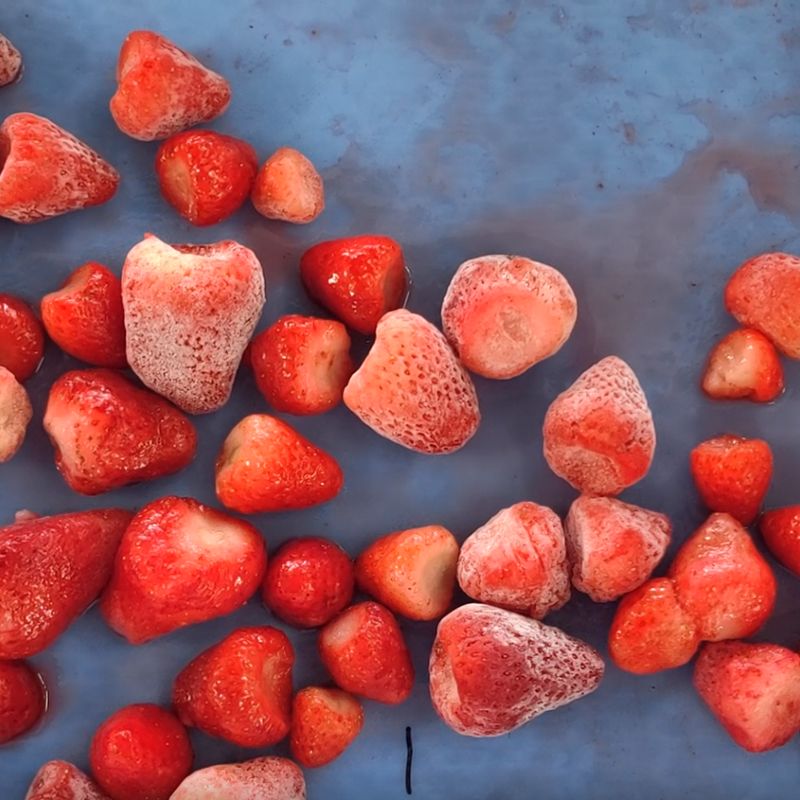
Questions like these are becoming increasingly important:
· How can hidden foreign materials be detected more reliably?
· How can irregular strawberries be inspected more consistently?
· How can product quality be maintained while reducing dependence on manual inspection?
Because different quality risks require different inspection methods, combining multi-view AI optical sorting with X-Ray inspection provides complementary inspection capabilities for more complete frozen strawberry quality control.
1. Key Quality Control Challenges in Frozen Strawberry Processing
Frozen strawberry processing involves several quality control challenges related to product characteristics, inspection consistency, and production requirements.
Unlike uniform industrial products, strawberries naturally vary in shape, surface structure, and product condition. Maintaining stable inspection performance while meeting high production requirements remains a key challenge for processors.
1.1 Foreign Material Control
Foreign material control is one of the most important quality concerns in frozen strawberry processing.
Because strawberries have a soft texture and complex surface structure, some foreign materials may remain attached to the product or become difficult to remove during conventional cleaning processes.
For processors, the challenge is not only detecting foreign materials, but also ensuring consistent control throughout continuous production.
1.2 Complex Surface and Appearance Inspection
Whole frozen strawberries are challenging to inspect due to their natural appearance variations.
Their irregular shapes and uneven surfaces can make consistent visual inspection more difficult, especially under frozen processing conditions where frost, moisture, and product positioning may affect inspection results.
Maintaining reliable appearance inspection performance is therefore an important quality objective for processors supplying high-quality frozen strawberry products.
1.3 Inspection Efficiency and Production Requirements
Many frozen fruit processors still use manual sorting or final visual inspection as a supplement to automated inspection.
As production requirements and quality expectations continue to increase, companies are looking for more reliable automated inspection solutions to improve consistency and reduce dependence on manual inspection.
2. Why One Inspection Technology Is Not Always Enough
No single inspection technology is designed to detect every quality issue.
Optical sorting and X-Ray inspection evaluate different product characteristics, making them complementary rather than interchangeable.
For frozen strawberry processing, one technology focuses on external product quality, while the other provides additional inspection capability beyond surface appearance.
2.1 Multi-View Optical Sorting
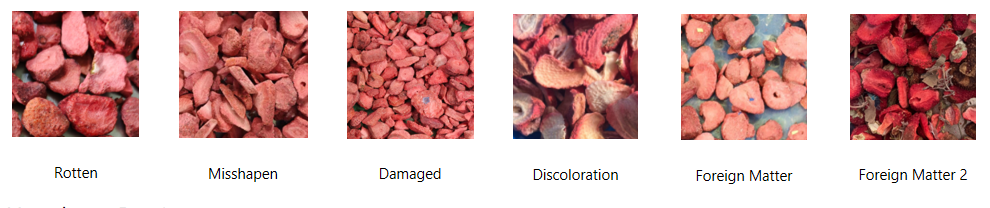
Multi-view optical sorting focuses on the external quality characteristics of frozen strawberries.
Key applications include:
· Detecting visible color defects
· Identifying shape defects
· Detecting visible foreign materials
· Inspecting multiple product surfaces
Multi-view optical sorting is particularly suitable for irregular strawberries, helping reduce inspection blind spots caused by product shape variations.
2.2 X-Ray Inspection
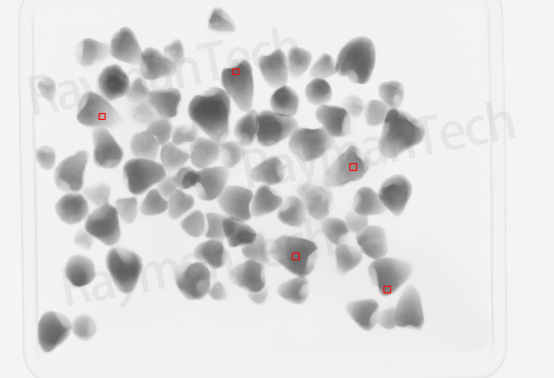
X-Rays can penetrate the product, allowing the system to identify foreign materials inside the product or attached to it.
This capability is particularly valuable for detecting small sand particles attached to or embedded in frozen strawberries.
X-Ray inspection complements optical sorting by providing inspection information beyond external appearance.
2.3 Why They Work Better Together
Each technology addresses different inspection challenges in frozen strawberry processing.
· Multi-view optical sorting focuses on external product appearance and visible quality variations.
· X-Ray inspection strengthens the detection of embedded or concealed foreign materials.
By combining both technologies, processors can establish a more complete inspection approach than relying on either technology alone.
This combined solution helps address both external quality variations and hidden foreign material risks, supporting more consistent quality control in frozen strawberry processing.
3. How RaymanTech Solves Frozen Strawberry Inspection Challenges
3.1 Processor Background
A frozen fruit processor purchased strawberries from external suppliers and supplied frozen strawberry products to customers in bakery, dairy, and other food processing applications where strict quality requirements are common.
The processor was looking for a more reliable quality control solution to:
· Strengthen foreign material control
· Improve inspection consistency
· Reduce quality risks during production
3.2 Customer Challenges
Challenge 1: Sand-Related Customer Complaints
One of the most challenging foreign material risks was sand attached to or embedded in frozen strawberries.
During drag harvesting, small sand particles (approximately 1–2 mm) could adhere to the fruit surface or become embedded in the soft strawberries.
Although washing could remove many loose contaminants, tightly attached or embedded sand could remain. Since these particles were difficult to identify through external appearance alone, they created a risk of customer complaints and rejected products.
Challenge 2: Reducing Manual Sorting Pressure
To maintain strict product quality requirements, the processor relied on manual sorting and final visual inspection.
As production requirements increased, the company looked for ways to:
· Reduce manual sorting workload
· Improve inspection consistency
· Maintain stable quality during continuous production
3.3 Why the Combined Solution Was Selected
For this application, the processor needed a solution that could manage both visible quality variations and hidden foreign material risks within one production process.
· Appearance-related defects and visible foreign materials required optical inspection.
· Embedded or attached foreign materials required additional X-Ray inspection capability.
A single inspection method could not provide complete quality control for this application.
Therefore, RaymanTech combined multi-view AI optical sorting with bulk X-Ray inspection to create a more comprehensive inspection process for frozen strawberries.
3.4 RaymanTech Inspection Solution
To address these challenges, RaymanTech recommended combining:
· Multi-View AI Belt Optical Sorting
· Intelligent Bulk X-Ray Inspection
The solution was designed around the specific quality risks identified in this application:
· Optical sorting for external appearance control and visible quality variations
· X-Ray inspection for hidden or difficult-to-detect foreign materials
Each technology addressed a different inspection requirement while working together as part of a complete frozen strawberry quality control process.
Multi-View AI Belt Optical Sorting
The RaymanTech multi-view AI belt optical sorter focused on external product quality and visible foreign materials.
Multi-view imaging captured strawberry information from different angles, helping reduce inspection blind spots caused by irregular shapes and uneven surfaces.
Typical sorting targets included:
· Plant residues such as leaves and stems
· Insects and visible foreign materials
· Immature or partially white strawberries
· Color, shape, and appearance defects
AI-powered classification helped improve sorting consistency and adapt to natural variations between raw material batches.
For specific applications, an optional near-infrared (NIR) module can further support the identification of foreign materials with similar visual appearances.
Intelligent Bulk X-Ray Inspection
The RaymanTech bulk X-Ray inspection system used the ability of X-Rays to penetrate the product and identify foreign materials that were difficult to detect through external inspection.
For this application, the primary inspection targets included:
· Sand embedded in strawberries
· Sand attached to the fruit surface
· Small dense foreign materials
· Other detectable metal and non-metal foreign materials, depending on the application
AI-assisted image analysis supported the recognition of small and irregularly shaped foreign materials.
3.5 Product Formats and Reference Throughput
The combined solution is suitable for:
· Whole IQF strawberries
· Frozen strawberry slices
The reference processing capacity is approximately 3.0–3.5 metric tons per hour, depending on product conditions, feeding configuration, and application requirements.
4. Results and Application Benefits
4.1 Reduced Sand-Related Complaint Risks
The combined inspection solution improved the processor’s ability to control sand contamination in frozen strawberries.
This helped reduce the risk of sand-related customer complaints and improved confidence in finished-product quality.
4.2 Improved Inspection Efficiency
By automating more inspection tasks, the processor reduced the workload associated with manual sorting and final visual inspection.
The combined solution helped achieve:
· More consistent inspection performance
· Reduced manual inspection pressure
· More stable production flow
4.3 Improved Product Quality Consistency and Customer Acceptance
More complete inspection coverage helped improve product quality consistency and reduce the risk of foreign materials or defective products reaching customers.
This supported more reliable quality assurance for frozen strawberry products used in quality-sensitive food applications.
4.4 Stronger Quality Management and Customer Confidence
The inspection process provided better visibility into incoming strawberry quality and foreign material risks.
This supported:
· Better raw material quality evaluation
· Stronger incoming quality control
· Improved confidence among food manufacturers and brand customers
A more complete inspection approach helped strengthen overall quality assurance and customer trust.
5. Frequently Asked Questions (FAQ)
Can RaymanTech Test Our Frozen Strawberry Samples Before Equipment Selection?
Yes.
RaymanTech can evaluate actual product samples to assess:
· Defect detection capability
· Foreign material detection capability
· Rejection performance
· Good product carryover
· Processing capacity
· Overall application suitability
Testing actual strawberries before equipment selection helps processors better understand expected inspection performance under their own application conditions.
Can X-Ray Inspection Detect Sand Embedded in Frozen Strawberries?
X-Ray inspection can help detect sand attached to or embedded in frozen strawberries under suitable application conditions.
Actual detection performance depends on factors such as:
· Sand size and density
· Product thickness
· Product condition
· Feeding configuration
· Equipment settings
Product sample testing is recommended to verify inspection performance under actual production conditions.
Why Is Additional Inspection Needed After Strawberries Have Been Washed?
Washing is an important step for removing loose contaminants, but it does not replace inspection for hidden foreign materials or appearance defects.
Optical sorting and X-Ray inspection provide additional quality control after washing by addressing different types of quality risks.
6. Improve Frozen Strawberry Quality Control with a Combined Inspection Solution
Every frozen strawberry application has different raw material conditions, quality requirements, and inspection challenges.
RaymanTech can evaluate your strawberry samples and recommend an appropriate combination of multi-view AI optical sorting and bulk X-Ray inspection based on your production requirements.
Contact RaymanTech to discuss your application or arrange a product sample test.





Follow us:
