
 English EN
 Germany DE
 French FR
 Portuguese PT
 Spanish ES
Specialized X-ray Inspection Solutions for Dry, Wet, Frozen, and Freeze-Dried Pet Food
In this guide, we explore how a commercial Pet Food x-ray machine safeguards production lines and why choosing the right Pet Food X-ray inspection machine manufacturer is critical for operational excellence.
Specialized Solutions for Every Pet Food Category
The pet food market is diverse, and each product type presents unique inspection challenges. According to the industry's latest technical standards, here is how X-ray technology is applied across different segments:
Product Category | Sub-categories | Critical Inspection Points & Contaminants |
Dry Dog and Cat Food (Kibble) | Dry Dog/Cat Food | Metal (production line parts, welding slag, stainless steel mesh), stone, glass, and missing desiccants/deoxidizers. |
Wet (Canned) Pet Food | Canned Dog/Cat Food | Bone fragments, metal, stone, rigid plastics, ceramics, glass. Includes packaging integrity (dented/deformed cans). |
Frozen Pet Food | Raw/Cooked Frozen Food | Bone fragments, metal, stone, rigid plastics, ceramics, and glass. |
Pet Treats and Biscuits | Biscuits, Cookies, Treats | Bone fragments, metal (inc. stainless steel mesh), stone, rigid plastics, and missing desiccants/deoxidizers. |
Freeze-Dried Pet Food | Raw Food, Treats | Bone fragments, metal, stone, rigid plastics, and missing desiccants/deoxidizers. |
Dehydrated Pet Food | Dehydrated Dog/Cat Food | Bone fragments, metal, stone, rigid plastics, and missing desiccants/deoxidizers. |
Pet Food Ingredients | Meat, Grains, Vegetables | Bone fragments, metal, stone, rigid plastics, ceramics, and glass in raw materials. |
Detailed Application Analysis
1.Dry Dog and Cat Food (Kibble) x-ray machine
Kibble production involves high-speed lines and bulk movement. A Dry Dog and Cat Food x-ray machine is designed to handle "bulk flow," detecting not just metal but also the fine stainless steel mesh wires that often break off from sifting equipment. Additionally, it ensures that every bag contains its required freshness packet (desiccant).
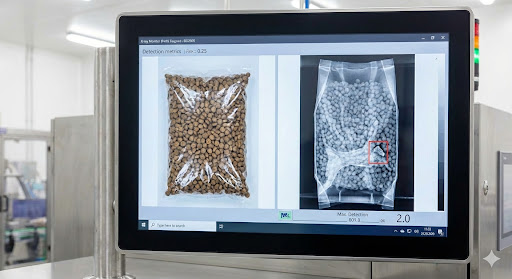
RaymanTech AI X-Ray Inspection System for Bulk Products
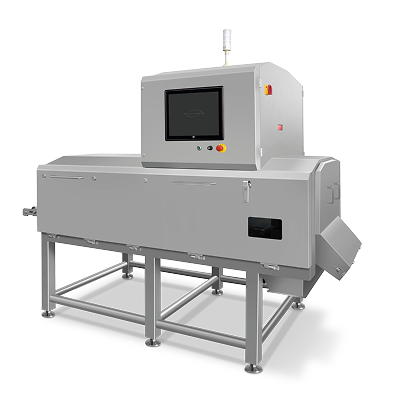
Conventional and unconventional contaminant detection, high-precision air jet rejector with minimal waste.
Model: RXI-4010BHD / 6010BHD /8010BHD, RXI-4010BHD VI / 6010BHD VI
2. Wet (Canned) Pet Food x-ray machine
Canned products are notoriously difficult for traditional detectors. A Canned Pet Food x-ray machine specializes in "side-view" or "dual-beam" inspection to look through the metal walls of the can. Beyond contaminants, it checks for fill levels and identifies dented or deformed cans that might compromise seal integrity.

RaymanTech X-Ray Inspection System for Bottled, Jarred & Canned Food is an advanced solution for detecting foreign contaminants such as broken glass pieces, metal shavings, ceramic, stone, and other impurities that may remain in containers during food production. Utilizing RaymanTech's self-developed multi beam imaging and AI-driven algorithm, the system ensures high-precision inspection across critical areas like bottle bodies, bottoms, screw mouths, tinplate can rings, and container edges. It is designed to handle various container types including glass bottles, metal cans, plastic cans with diverse food forms such as powders, granules, solids, semi-fluids, and liquids.
3. Frozen and Raw Pet Food x-ray machine
For raw and frozen diets, the primary concern is often bone fragments. A x-ray machine for frozen and raw pet food utilizes high-definition (UHD) sensors to distinguish between the density of frozen meat and dangerous bone shards, ensuring the safety of raw-fed pets.

UHD X-Ray Inspection System for Packaged Food Products
Ultra-fine contaminants detection, UHD X-Ray detector, AI large model.
Model: RXI-2416 / 4016 / 4030 / 5030 / 6030 / 8040
4. Specialized Treats and Freeze-Dried Products
Whether you need a Pet Treats and Biscuits x-ray machine, a Freeze-Dried Pet Food x-ray machine, or a Dehydrated Pet Food x-ray machine, these systems focus on "completeness." They verify the count of items in a pack and ensure that oxygen absorbers are present to prevent spoilage.
5. Pet Food Ingredients x-ray machine
Safety begins at the source. Implementing a Pet Food Ingredients x-ray machine at the beginning of the production line protects your downstream machinery from damage caused by stones or large metal pieces in raw grains or meat meals.
The Future: AI and UHD Technology
Top-tier Pet Food X-ray machine manufacturers like RaymanTech are now integrating Artificial Intelligence (AI) and Ultra-High Definition (UHD) resolution. AI-powered algorithms can "learn" the normal texture of a product, making them significantly better at spotting low-density contaminants like plastic or rubber that were previously invisible.
Conclusion
Investing in a Pet Food x-ray machine is more than just a safety check—it is an investment in your brand's reputation. By choosing a system tailored to your specific application—whether it’s kibble, canned, or freeze-dried—you ensure compliance with global safety standards like HACCP and FSMA.
Frequently Asked Questions (FAQs)
Q: Can a Pet Food x-ray machine detect metal inside foil packaging?
A: Yes. Unlike metal detectors, X-ray systems are not affected by metallic packaging. They can easily see through foil pouches or aluminum cans to find contaminants.
Q: How does the machine handle missing desiccants in treats?
A: Modern X-ray systems can be programmed to recognize the specific shape and density of desiccant or deoxidizer packets. If a packet is missing, the system automatically triggers a reject mechanism.
Q: Can X-ray inspection detect bone fragments in raw pet food?
A: Absolutely. This is one of the strongest advantages of X-ray technology. It can distinguish between meat and denser bone fragments, which is critical for raw and wet food safety.
Q: Is X-ray inspection safe for the pet food itself?
A: Yes. The levels of radiation used in food inspection are extremely low and do not affect the nutritional value, flavor, or safety of the pet food.
Q: What is the benefit of a UHD (Ultra-High Definition) X-ray system?
A: UHD systems provide much higher resolution images, allowing for the detection of "micro-contaminants"—tiny fragments of wire or stone that standard systems might miss.

Related Articles
-
 Jan-21-2026
RaymanTech X-ray Inspection Systems: The Complete Guide to a Smarter, Safer Production Line
When a single shard of glass, a fragment of bone, or an unnoticed plastic tie can trigger a multimillion-dollar recall and shatter consumer trust, food manufacturers can no longer rely on yesterday’s detection technology. RaymanTech has built an entire ecosystem of X-ray inspection solutions that go far beyond traditional metal detectors, delivering density-based, shape-aware, AI-enhanced inspection across every product format imaginable.learn more -
 Jan-21-2026
Introduction to RaymanTech Optical Sorters for Farm Products and Food Processors
RaymanTech, as a leading provider of inspection and sorting solutions, has developed a comprehensive optical sorter portfolio that now serves both farm-product applications and food-processing environments. While farm-product sorters focus on capacity, adaptability, and raw-material variability, food-processor-grade sorters must also incorporate high IP protection, robust stainless-steel construction, sanitary design, and harsh washdown compatibility.learn more -
 Jan-21-2026
How Safe is X-ray Inspection of Food?
Consumers and manufacturers alike worry about contamination in food – broken glass, metal fragments, plastic or stone – entering a product and harming someone or prompting a recall. X-ray inspection systems have become a key solution: conveyors carrying packaged or unpackaged food pass through a shielded X-ray machine that “sees” inside each item. This technology complements traditional metal detectors and manual checks to catch a wider range of hazards. Importantly, extensive research and industry experience show that food X-ray inspection is extremely safe. Nearly everything we eat – from spices to snacks – is X-rayed at some point during production, and regulatory bodies (like the FDA) report “no known adverse effects” from the low-dose X-ray scans used in food plants.learn more




Follow us:


